
Matariki is the Māori name for the Pleiades star cluster, marking the beginning of the Māori New Year. While often recognized as seven stars, the full cluster comprises nine visible stars: Matariki, Pōhutukawa, Tupuānuku, Tupuārangi, Waitī, Waitā, Waipunarangi, Ururangi, and Hiwa-i-te-rangi. Each star holds dominion over specific environmental elements, such as food sources, weather, and the spirits of the deceased.
Understanding the Matariki Cluster
Matariki is more than just a celestial event; it is a fundamental pillar of timekeeping, cultural identity, and environmental stewardship in New Zealand. Known elsewhere in the world as the Pleiades, the Seven Sisters, or Subaru, this cluster appears in the pre-dawn sky of mid-winter. For Māori, the rising of these stars signals the end of one year and the beginning of the next.
Historically, there has been some debate regarding the number of stars. While many cultures identify seven stars, Māori astronomy (tātai arorangi) specifically identifies nine distinct stars within the narrative of the cluster. This distinction is vital because each of the nine stars carries a specific responsibility that dictates the health of the community and the success of the coming harvest. Understanding the Matariki star names provides a blueprint for living in harmony with the natural world.
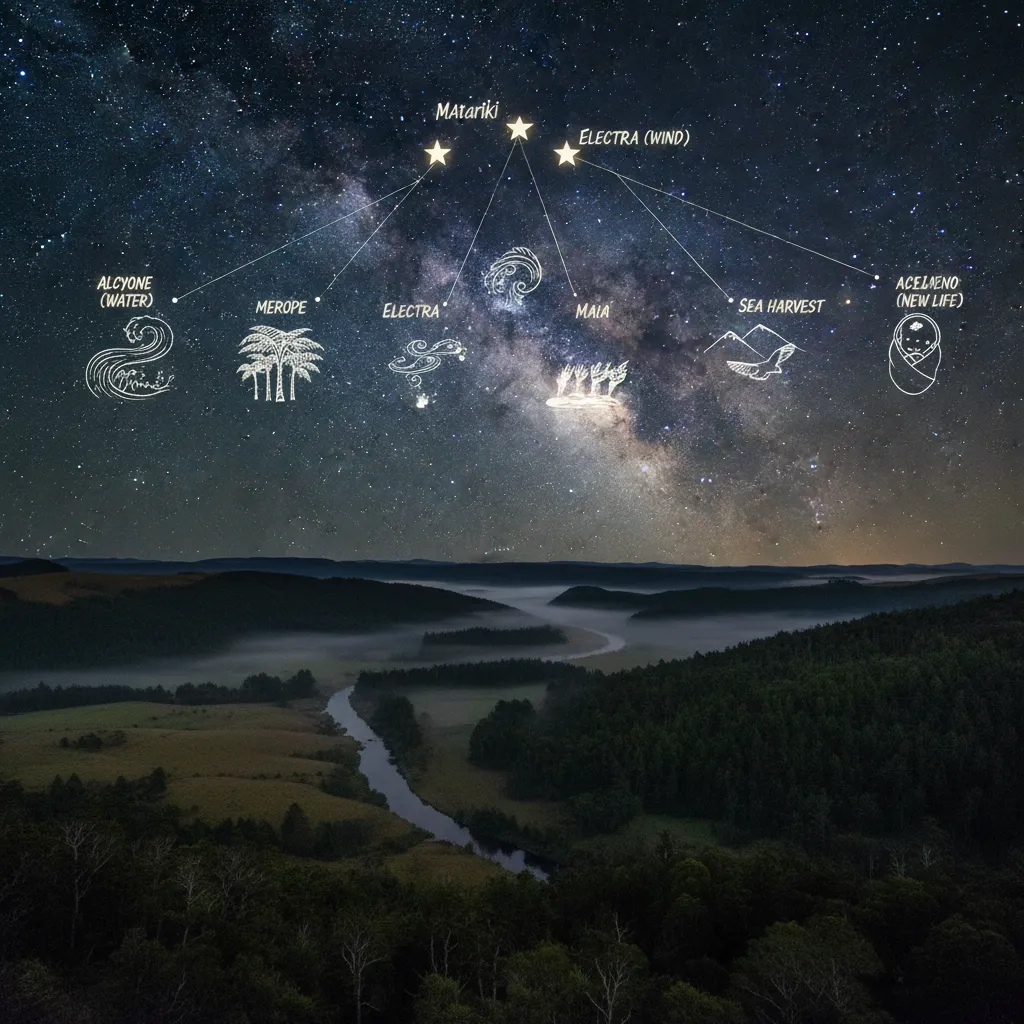
The 9 Matariki Star Names and Meanings
The cluster is viewed as a whānau (family). Matariki is the mother, surrounded by her eight children. Each child star connects to a specific domain of the te taiao (the natural world). Below is a comprehensive breakdown of each star, their significance, and what they represent for the year ahead.
1. Matariki (The Mother)
Domain: Reflection, hope, health, and the connection of people.
The star named Matariki is the conductor of the ensemble. As the mother of the other stars in the cluster, her position is central. She signifies the overall wellbeing of the people. When Matariki is bright and clear in the pre-dawn sky, it is interpreted as a sign of good luck, peace, and health for the coming year. If she appears hazy or shimmering, it may predict sickness or a difficult winter.
Culturally, this star encourages us to gather together. It is a time to check in on the health of our community and our families. It represents the concept of whakawhanaungatanga (building relationships) and ensures that as we enter the New Year, we are united and healthy.
2. Pōhutukawa (The Star of Remembrance)
Domain: The spirits of the dead (te hunga mate).
Pōhutukawa is the star that connects the living to those who have passed away since the last rising of Matariki. It is the oldest child. In Māori tradition, when people die, their spirits travel up to the north of the North Island to Te Rerenga Wairua (Cape Reinga), slide down the pōhutukawa root into the underworld, and eventually ascend to the heavens to become stars.
During the New Year celebrations, this star prompts the weeping for the dead (tangihanga). It is a time to call out the names of those lost in the previous year, acknowledging their impact on our lives and releasing them to become part of the night sky. This process allows the living to grieve properly and prepare for the new year with a lighter heart.

3 & 4. Tupuānuku and Tupuārangi (Food Sources)
These two stars are often discussed together as they represent the bounty of the earth and the sky.
Tupuānuku
Domain: Food that grows within the soil.
The name breaks down to ‘tupu’ (to grow) and ‘nuku’ (short for Papatūānuku, the Earth Mother). Tupuānuku governs all edible plants that are harvested from the ground, such as kūmara (sweet potato), rīwai (potatoes), and carrots. A bright Tupuānuku indicates a fruitful harvest and fertile soils for the coming planting season. It reminds us of the importance of soil health and sustainable gardening practices.
Tupuārangi
Domain: Food that grows in the sky (trees).
‘Rangi’ refers to Ranginui (the Sky Father). This star is associated with things that grow above our heads: fruits, berries, and native birds (which were traditionally a food source like the kererū). Tupuārangi is linked to the abundance of the forests. If this star is dim, it might suggest a scarcity of berries, which in turn affects the bird populations. It serves as an ecological indicator for the health of the ngahere (forest).
5 & 6. Waitī and Waitā (Water Bodies)
Just as there are stars for the land, there are twins that watch over the water.
Waitī
Domain: Fresh water and the creatures within it.
Waitī watches over all freshwater bodies: lakes, rivers, streams, and springs. It is particularly associated with the food sources found within these waters, such as tuna (eels), kōura (crayfish), and īnanga (whitebait). The clarity of this star signals the health of the waterways. In modern times, Waitī serves as a critical reminder of water conservation and the fight against pollution in our rivers.
Waitā
Domain: Salt water and the ocean.
Waitā represents the vast ocean (Te Moana-nui-a-Kiwa) and the seafood harvested from it (kaimoana). This includes snapper, kahawai, shellfish, and seaweed. Waitā is significant because Māori were master navigators; this star acknowledges the ocean not just as a food basket, but as the highway that brought ancestors to Aotearoa. A clear Waitā predicts calm seas and abundant fishing.

7 & 8. Waipunarangi and Ururangi (The Elements)
These stars dictate the atmospheric conditions for the coming year.
Waipunarangi
Domain: Rain.
Waipunarangi translates roughly to “water that pools in the sky.” This star is responsible for the rainfall patterns. While rain is necessary for the harvest (connecting it to Tupuānuku), too much can cause flooding, and too little causes drought. Observing Waipunarangi helps tohunga (experts) predict whether the winter will be wet or dry, allowing communities to prepare their crops and settlements accordingly.
Ururangi
Domain: Winds.
Ururangi means “the winds of the sky.” This star determines the nature of the winds for the year. It is associated with the four winds (North, South, East, West). The visibility of Ururangi can help predict the severity of storms or the calmness of the season. For a seafaring nation, the mood of Ururangi was critical for safe travel.
9. Hiwa-i-te-rangi (The Wishing Star)
Domain: Growth, prosperity, and the granting of wishes.
Hiwa-i-te-rangi is the youngest star in the cluster. She is the star to whom you send your wishes and aspirations for the coming year. Similar to the Western concept of “wishing upon a star,” Māori would send their dreams for prosperity, success, and happiness to Hiwa-i-te-rangi. This star represents the future and our ability to shape it through intention and planning. It is the star of goal setting.
How to Locate Matariki in the Sky
To view the Matariki star names in their celestial arrangement, you must look to the eastern horizon before the sun rises (pre-dawn) during mid-winter (typically late June or July). Here is a simple method to find the cluster:
- Find Orion’s Belt: Look for the distinct row of three stars that make up the bottom of “The Pot” (or Tautoru).
- Follow the Line: Draw an imaginary line from Tautoru (Orion’s Belt) extending to the left (northward).
- Locate Te Kokotā: You will pass a bright triangular cluster known as Te Kokotā (The Face of the Hyades).
- Arrive at Matariki: Keep following that line to the left until you see a small, shimmering cluster of stars. That is Matariki.
Pronunciation Guide
Correct pronunciation is essential for respecting the mana of these stars. Here is a guide to help you articulate the names correctly. Remember that vowels in Māori are generally pronounced: ‘a’ as in car, ‘e’ as in egg, ‘i’ as in eat, ‘o’ as in or, ‘u’ as in to.
- Matariki: Mah-tah-ree-key
- Pōhutukawa: Paw-hoo-two-cah-wah
- Tupuānuku: Two-poo-ah-nook-oo
- Tupuārangi: Two-poo-ah-rung-ee
- Waitī: Why-tee
- Waitā: Why-tah
- Waipunarangi: Why-poo-nah-rung-ee
- Ururangi: Oo-roo-rung-ee
- Hiwa-i-te-rangi: Hee-wah-ee-teh-rung-ee
Frequently Asked Questions
Why do some people say there are only 7 stars in Matariki?
The visibility of the stars depends largely on atmospheric conditions and eyesight. In many cultures, including Greek and some Māori iwi, only the seven brightest stars are typically counted. However, in the specific Māori narrative championed by experts like Dr. Rangi Mātāmua, nine stars are identified, with Pōhutukawa and Hiwa-i-te-rangi being the additional two often excluded in other traditions.
What is the best time to see Matariki?
The best time to view Matariki is in the early morning, just before dawn, typically between 5:30 AM and 6:30 AM. The viewing period usually begins in late June or early July, depending on the lunar calendar (Maramataka) phase for that specific year. You can use our Interactive Night Sky Map Tool: Locate Matariki Now for precise timing based on your location.
Does Matariki disappear?
Yes, the Matariki cluster sets in the west during the early evening in the warmer months and eventually disappears from view entirely around May. Its reappearance in the pre-dawn sky in mid-winter signals the New Year. This period of invisibility is often associated with the stars returning to the underworld to gather the spirits of the dead. Understanding how the stars move is key to celestial navigation; for more on this, see our guide on the Phases of the Moon.
How is Matariki celebrated today?
Modern Matariki celebrations involve a mix of traditional and contemporary practices. These include the Hautapu ceremony (cooking food so the steam feeds the stars), remembrance of loved ones, community feasts, planting trees, and setting goals for the year ahead. It is now an official public holiday in New Zealand. Many communities prepare special feasts; check out our collection of Modern Matariki Hākari Recipes.
What does the name Matariki literally mean?
Matariki is often translated as “Ngā Mata o te Ariki” (The Eyes of the God) or simply “Little Eyes” (Mata riki). One legend suggests that the god Tāwhirimātea, in his anger at the separation of the sky and earth, crushed his eyes and threw them into the heavens, creating the cluster.
Are Matariki and the Pleiades the same thing?
Yes, astronomically they are the same star cluster (Messier 45). However, culturally they carry different meanings. While the Greeks saw them as the Seven Sisters, and the Japanese as Subaru, for Māori, they are Matariki and her children, carrying specific environmental and spiritual significance unique to Aotearoa.