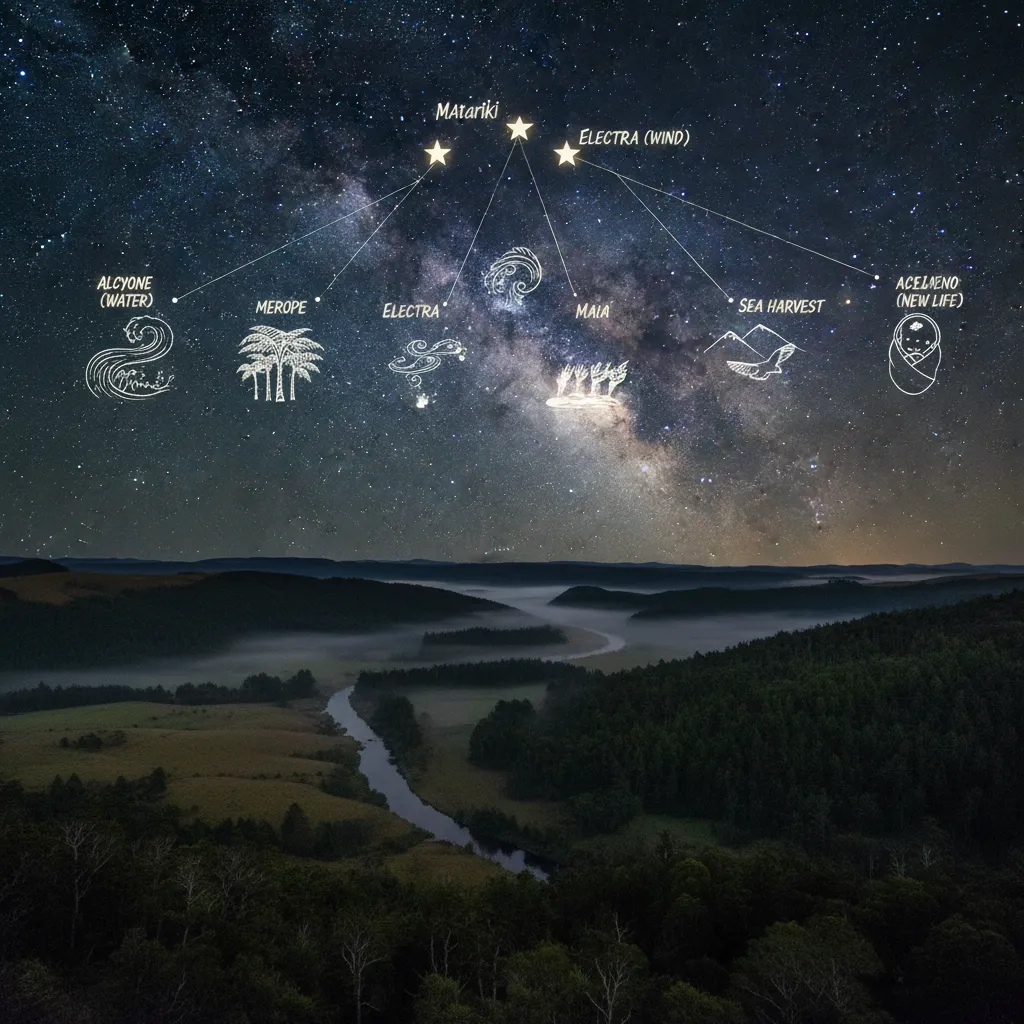
The 9 stars of Matariki meanings represent specific environmental domains and cultural values within the Māori New Year. Matariki (health), Pōhutukawa (remembrance), Tupuānuku (earth food), Tupuārangi (sky food), Waitī (freshwater), Waitā (ocean), Waipunarangi (rain), Ururangi (wind), and Hiwa-i-te-rangi (wishes) collectively guide harvest, mourning, and future aspirations.
Matariki is not merely a cluster of stars; it is a complex environmental calendar and a spiritual guide for the Māori people of Aotearoa New Zealand. Known astronomically as the Pleiades, this cluster reappears in the pre-dawn sky in mid-winter, signaling the start of the Māori New Year. While many cultures recognize seven stars, Māori astronomy identifies nine distinct stars, each presiding over a specific domain of the natural world and human existence.
What are the 9 Stars of Matariki Meanings and Domains?
Understanding the 9 stars of Matariki meanings requires looking beyond the sky and into the ecosystem. Each star acts as one of the Seasonal Signs (Tohu) for the coming year, predicting productivity in fishing, planting, and weather patterns. When the cluster rises, tohunga (experts) would historically observe the brightness and clarity of each individual star to forecast the prosperity of the tribe for the season ahead.

Who is Matariki? (The Mother Star)
Meaning: Health, Wellbeing, and Reflection
Domain: People and Holistic Health
Matariki is the central star of the cluster, often referred to as the mother surrounded by her eight children. Her name serves as the identifier for the entire cluster, but as an individual star, she holds a distinct responsibility. Matariki signifies reflection, hope, and the connection to the environment. She is the conductor of the ensemble, ensuring that the other stars function in harmony.
In traditional observation, if the star Matariki appeared bright and clear, it signaled a year of good luck, health, and peace. Conversely, if she appeared hazy or dim, it could foretell sickness or hardship. Today, Matariki is a time for communities to come together, check on one another’s wellbeing, and reset their intentions for healthy living in the coming year.
What is the Meaning of Pōhutukawa?
Meaning: Remembrance and The Dead
Domain: The Spirits of the Deceased
Pōhutukawa is the star connected to those who have passed away since the last rising of Matariki. This star carries the heavy but necessary burden of mourning. In Māori belief, when individuals die, their spirits travel to Te Rerenga Wairua (the leaping place of spirits) and eventually ascend into the heavens to become stars. Pōhutukawa guides these spirits on their journey.
During the Matariki celebrations, distinct ceremonies are held to call out the names of those lost during the year. This is a time of “weeping and greeting”—acknowledging the pain of loss while celebrating the legacy left behind. It allows the living to process their grief fully before moving into the new year with a lighter heart.
What Do Tupuānuku and Tupuārangi Represent?
These two stars are the guardians of food sources, splitting their duties between the earth below and the canopy above.
Tupuānuku: Food from the Earth
Meaning: Cultivated Food and Harvest
Domain: Soil, Plants, and Gardens
The name Tupuānuku translates roughly to “to grow in the earth.” This star is associated with all edible plants grown in the soil, such as kūmara (sweet potato) and other root vegetables. Tupuānuku is a vital indicator for agriculture. A bright Tupuānuku indicates a bountiful harvest and fertile soils for the planting season ahead. It reminds us of the importance of soil health and the cyclical nature of planting and harvesting.

Tupuārangi: Food from the Sky
Meaning: Birds, Berries, and Fruits
Domain: Forests and Canopy
Contrasting with her sibling, Tupuārangi means “to grow in the sky.” This star is connected to food sources that are located above the ground. This includes native birds like the kererū, as well as fruits and berries found on trees. Historically, Tupuārangi was essential for hunters and gatherers. The visibility of this star would help predict the abundance of birdlife and the readiness of forest resources. It emphasizes the concept of kaitiakitanga (guardianship) over our forests and native bush.
How Do Waitī and Waitā Influence the Environment?
Water is the lifeblood of the Māori world, and the twin stars Waitī and Waitā govern the hydrological systems of Aotearoa.
Waitī: Fresh Water Bodies
Meaning: Fresh Water and Eels
Domain: Lakes, Rivers, and Streams
Waitī watches over all fresh water environments. This star is linked to the creatures that inhabit these waters, specifically the tuna (eel) and kōura (crayfish). The health of Waitī in the dawn sky is seen as a reflection of the health of the rivers and lakes. If the star is distinct, the water quality is expected to be good, and food sources plentiful. Waitī reminds us that fresh water is a finite resource that sustains all land-based life.
Waitā: Salt Water and the Ocean
Meaning: The Ocean and Seafood
Domain: The Sea (Moana)
Waitā represents the vast ocean and the abundant food sources within it, known as kaimoana. This star is associated with the tides, currents, and the myriad of life forms from fish to shellfish. Waitā is often linked to the kahawai and snapper runs. For coastal iwi (tribes), the appearance of Waitā was critical for planning fishing expeditions. It underscores the deep connection Māori have as voyagers and island people to the Pacific Ocean.

What is the Significance of Waipunarangi and Ururangi?
These two stars are the meteorological experts of the cluster, governing the atmospheric conditions that dictate the success of the harvest and the safety of travel.
Waipunarangi: The Rains
Meaning: Water that Pools in the Sky
Domain: Rain, Hail, and Snow
Waipunarangi translates to “water that pools in the sky.” This star is responsible for rainfall. While rain is necessary for the growth of crops (linked to Tupuānuku), excessive rain can cause flooding and rot. The appearance of Waipunarangi helps tohunga predict rainfall patterns for the coming winter and spring. It teaches us to respect the water cycle and the balance required between sun and rain for life to flourish.
Ururangi: The Winds
Meaning: The Winds of the Sky
Domain: Wind Patterns and Gales
Ururangi is connected to the winds (ngā hau). The name means “the winds of the sky.” In New Zealand, the wind can be a volatile force, ranging from gentle breezes to destructive gales. Ururangi determines the nature of the winds for the year. A flickering Ururangi might suggest a year of turbulent weather. Understanding the wind was crucial for navigation, both on land and sea, and for the structural integrity of crops and buildings.
Why is Hiwa-i-te-rangi Called the Wishing Star?
Meaning: Growth, Prosperity, and Aspirations
Domain: Future Goals and Dreams
Hiwa-i-te-rangi is perhaps the most personal star for many people today. She is the youngest star in the cluster and is known as the “wishing star.” Unlike the others, which are tied to specific physical environmental domains, Hiwa-i-te-rangi is connected to the abstract concepts of hope and ambition.
Traditionally, Māori would send their wishes for the new year to Hiwa-i-te-rangi. This practice is similar to the Western concept of “wishing upon a star.” During Matariki celebrations, it is common to set goals, plan for the future, and articulate deep desires for prosperity and happiness. Hiwa-i-te-rangi encourages us to look forward with optimism, teaching that while we must respect the past (Pōhutukawa), we must also actively shape our future.
The Cultural Revival of Matariki
The resurgence of knowledge regarding the 9 stars of Matariki meanings marks a significant turning point in New Zealand’s cultural identity. For many years, the specific knowledge of the nine stars was held by only a few experts. However, through the work of scholars like Dr. Rangi Mātāmua, this astronomical wisdom has been returned to the public domain.
Matariki is now an official public holiday in New Zealand, the first to recognize Te Ao Māori (the Māori worldview) exclusively. This revival is not just about a day off work; it is about realigning human activity with the natural environment. By understanding the domains of Tupuānuku, Waitī, and Ururangi, New Zealanders of all backgrounds are learning to read the environment and respect the seasonality of nature.
How to Observe the Stars
To view the Matariki cluster, one must look to the northeast horizon before the sun rises in mid-winter (usually late June or July). The best time is between 5:30 AM and 6:30 AM.
- Find the row of three stars known as Tautoru (Orion’s Belt).
- Trace a line northward from Tautoru to the triangular cluster of Te Kokotā (The Hyades).
- Continue that line to the left until you see the cluster of faint stars that looks like a small shimmer of light. That is Matariki. For precise guidance, you can use our Interactive Night Sky Map Tool: Locate Matariki Now.
Each star in the cluster shines with a message. By observing them, we engage in a practice that is centuries old, connecting us to ancestors who looked at the same sky to navigate their lives.
Frequently Asked Questions About Matariki Stars
Why are there sometimes 7 stars and sometimes 9?
While the Pleiades cluster contains hundreds of stars, the naked eye typically sees seven. However, Māori astronomy, specifically the accounts preserved by Dr. Rangi Mātāmua from the Tūhoe region, identifies nine distinct stars. The two additional stars often missed by casual observers are Pōhutukawa and Hiwa-i-te-rangi.
When is the best time to see the 9 stars of Matariki?
The cluster is best viewed in the pre-dawn sky (around 5:30 AM to 6:30 AM) during the lunar phase of Tangaroa, usually in late June or early July. This marks the heliacal rising of the cluster.
What is the difference between Matariki and Puanga?
In some parts of New Zealand (like Taranaki and the West Coast), the Matariki cluster is obscured by mountains or geography. Tribes in these areas observe Puanga as the Harbinger of Winter (Rigel) as the signal for the New Year instead, though the meanings of harvest and remembrance remain similar.
Can I see all 9 stars with the naked eye?
It can be difficult to distinguish all nine individual stars without a telescope or very clear, dark skies free of light pollution. Historically, those with exceptional eyesight could distinguish them, which was crucial for making precise environmental predictions.
How do I pronounce the names of the stars?
Te Reo Māori pronunciation emphasizes vowel sounds: ‘A’ as in ‘car’, ‘E’ as in ‘egg’, ‘I’ as in ‘feet’, ‘O’ as in ‘or’, ‘U’ as in ‘to’. For example, Matariki is pronounced Mah-tah-ree-key.
Is Matariki celebrated the same way by all Māori tribes?
No, there are regional variations. While the core concepts of remembrance, harvest, and celebration are universal, specific narratives, the number of stars observed (7 or 9), and the timing can vary between iwi (tribes) based on their geographical location and tribal history.