
Hiwa-i-te-rangi is the youngest star in the Matariki cluster, representing the promise of a prosperous season. The meaning of Hiwa-i-te-rangi for goal setting involves projecting your ‘wawata’ (aspirations) and ‘tumanako’ (hopes) into the heavens, asking for guidance and energy to achieve specific desires in the coming Māori New Year.
Matariki, the Māori New Year, is a profound period of renewal, remembrance, and resetting. While the cluster contains nine distinct stars, each governing a specific environmental domain, one star stands apart in its purpose. Hiwa-i-te-rangi does not govern food, weather, or the harvest; instead, she governs the human spirit’s capacity to dream.
Understanding the meaning of Hiwa-i-te-rangi for goal setting transforms the modern practice of “New Year’s Resolutions” into a deeper, culturally grounded ritual. It moves beyond simple task lists and connects our future aspirations with the celestial energies recognized by ancestors for centuries.
What is the Mythology of Hiwa-i-te-rangi?
To fully utilize the energy of this star, one must first understand her place in the cosmology of Aotearoa. Hiwa-i-te-rangi is often referred to as the “wishing star,” drawing parallels to the Western notion of wishing upon a star, but her role is far more active and demanding.
In Māori mythology, Hiwa-i-te-rangi is the youngest child of Rehua (Antares) and Matariki (Alcyone). Because she is the youngest, she is associated with vigorous growth, similar to a young sapling that pushes through the forest floor toward the light. Her name translates loosely to “Hiwa in the sky,” where “Hiwa” implies being watchful, alert, and vigorous.

Unlike the other stars in the cluster—such as Tupu-ā-nuku (food from the earth) or Waitī (freshwater bodies)—Hiwa-i-te-rangi is not tied to a physical resource. She is the guardian of our aspirations. In traditional times, Māori would look to Hiwa-i-te-rangi to send their wishes for the coming year. It was believed that if the star appeared bright and clear, the year ahead would be favorable for achieving those goals. If she appeared hazy or shimmering erratically, it suggested that the path to one’s desires might be fraught with challenges.
This mythology underscores that the meaning of Hiwa-i-te-rangi for goal setting is not passive. It is about “sending” your wishes up to the star so that they become part of the celestial fabric of the year. It requires the clarity of mind to articulate exactly what you want.
How Does Manifestation Differ from Māori Intention Setting?
In the contemporary wellness sphere, “manifestation” is a buzzword often linked to the Law of Attraction—the idea that thinking positive thoughts attracts positive outcomes. While there are similarities, the Māori approach to intention setting through Hiwa-i-te-rangi is distinct in its communal and spiritual grounding.
The Concept of Wawata and Tumanako
Māori intention setting relies on two key concepts: wawata (aspirations/dreams) and tumanako (hope). When you engage with Hiwa-i-te-rangi, you are not simply asking the universe to deliver goods to your doorstep. You are aligning your mauri (life force) with the rhythm of the environment.
Traditional intention setting acknowledges that we are part of a larger ecosystem. A goal set during Matariki often considers the wellbeing of the whānau (family) and the whenua (land), not just the individual. For example, a modern manifestation goal might be “I want a promotion.” A Hiwa-i-te-rangi intention might be, “I seek the mana and capability to lead my community effectively.” The outcome may be the same (a promotion), but the intent is rooted in service and growth rather than acquisition.

The Balance of Pōhutukawa and Hiwa-i-te-rangi
Effective goal setting during Matariki requires balance. You cannot look to Hiwa-i-te-rangi (the future) without first acknowledging Pōhutukawa (the star connected to those who have passed). This duality is essential. You must release the burdens and grief of the past year to create spiritual space for the new aspirations you are sending to Hiwa-i-te-rangi. Modern manifestation often ignores the necessary step of grieving or releasing the past; Matariki makes it a prerequisite for success.
Rituals for Connecting with the Wishing Star
To authentically engage with the meaning of Hiwa-i-te-rangi for goal setting, you can incorporate specific rituals into your Matariki observance. These practices help solidify your intentions and signal to your subconscious that you are ready for change.
The Pre-Dawn Viewing
The most traditional way to connect is by viewing the cluster before the sun rises. This usually occurs in mid-winter (June or July in New Zealand).
- Find a Vantage Point: Go to a high point or a place with a clear view of the eastern horizon.
- Locate the Cluster: Find Tautoru (Orion’s Belt) and follow the line left to the pyramid shape of Te Kokotā, and then left again to Matariki.
- Voice Your Desires: It is traditional to speak your wishes aloud. The spoken word carries vibration and mana. Address Hiwa-i-te-rangi directly.
Te Umu Kohukohu Whetū (The Steaming Earth Oven)
Historically, offerings were made through Te Umu Kohukohu Whetū, where food was cooked in an earth oven, and the steam was allowed to rise to feed the stars. While you may not dig an earth oven, you can replicate this symbolically by sharing a hot meal with family before dawn, allowing the steam of your tea or food to rise as you discuss your hopes for the year. This act feeds the connection between the physical and spiritual realms.
Journaling Prompts for Matariki Reflection
Writing is a powerful tool for clarifying the meaning of Hiwa-i-te-rangi for goal setting in your personal life. By putting pen to paper, you move your wishes from the abstract to the concrete.

Use the following prompts to guide your session. It is best to do this during the period of Matariki, ideally in the quiet of the evening or early morning.
Reflecting on the Past (Pōhutukawa)
- What burdens, habits, or griefs am I carrying from the last year that are too heavy to take into the new year?
- Who has passed or left my life this year, and what lessons did they leave me with?
- What is one failure from the past year that I can now forgive myself for?
Looking to the Future (Hiwa-i-te-rangi)
- If I knew I could not fail, what is the one ‘wild’ wish I would send to Hiwa-i-te-rangi?
- How do I want to feel in my body, mind, and spirit by the time Matariki returns next year?
- What is a goal that benefits not just me, but my whānau or community?
- What seeds of talent or interest have I ignored that need to be watered this year?
How to Create a ‘Hiwa’ Board for the Year Ahead
Vision boards are a popular self-help tool, but a “Hiwa Board” is a culturally inspired variation that focuses on holistic wellbeing rather than just material accumulation. This board serves as a visual anchor for the meaning of Hiwa-i-te-rangi for goal setting.
Step 1: Structure by the Stars
Instead of a random collage, structure your board according to the domains of the Matariki stars. This ensures a balanced life.
- Tupu-ā-nuku (Earth/Soil): Goals related to gardening, diet, or grounding.
- Tupu-ā-rangi (Sky/Birds): Goals related to spiritual connection, song, or mental clarity.
- Waitī (Freshwater): Goals for emotional health and hydration.
- Waitā (Saltwater): Goals for travel, adventure, or connection to the ocean.
- Waipuna-ā-rangi (Rain): Goals for emotional release and cleansing.
- Ururangi (Wind): Goals for adaptability and handling change.
- Hiwa-i-te-rangi (Wishes): Your biggest, most audacious dream.
Step 2: Use Natural Materials
incorporate elements of nature onto the board. Use dried leaves, feathers, or sand to represent the domains. This keeps the board grounded in the physical world, reminding you that goals require action in reality, not just thoughts.
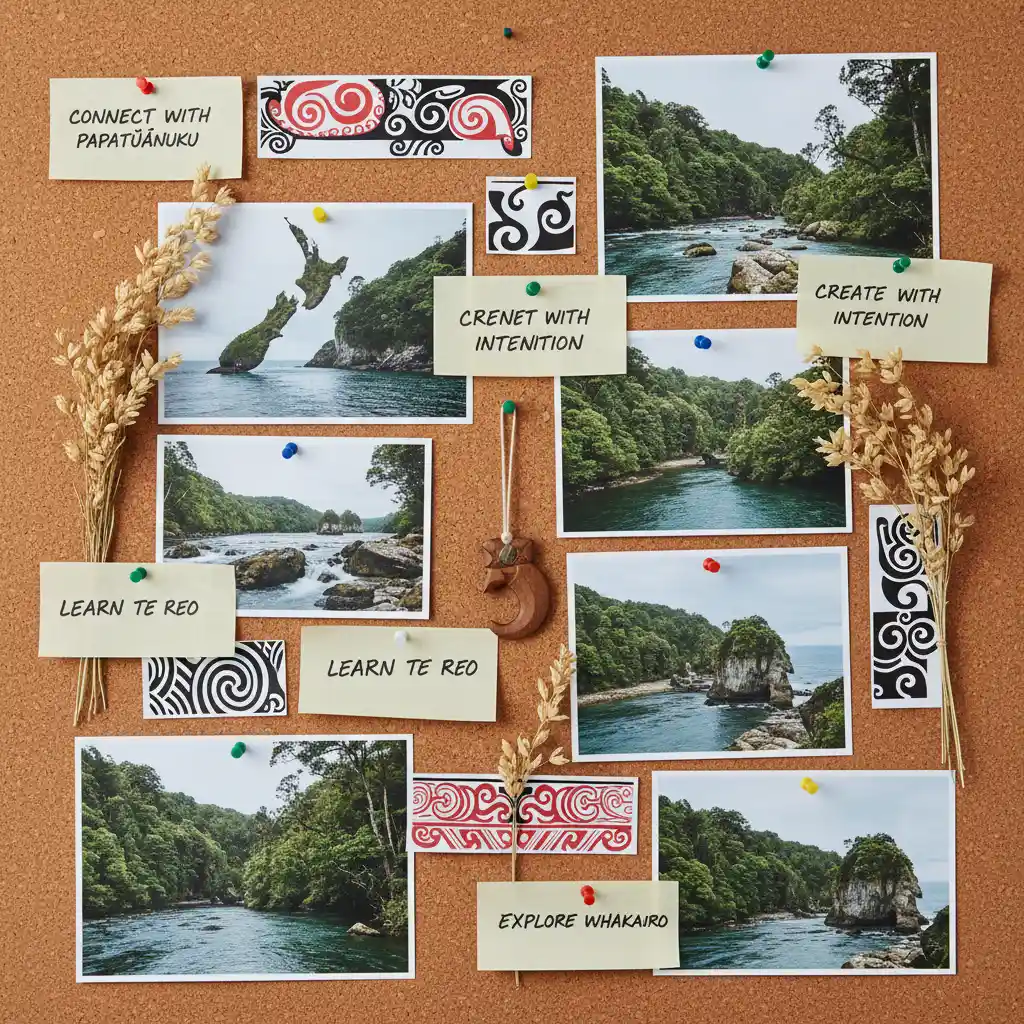
Step 3: The Activation Ritual
Once your board is complete, do not just hang it on the wall. Perform a small activation. Light a candle (representing the light of the stars), stand before your board, and recite a simple karakia or affirmation. State clearly: “These are my wishes for Hiwa-i-te-rangi. I am ready to receive them and work for them.”
By integrating the mythology, the rituals, and the practical application of the Hiwa Board, you honor the traditions of Aotearoa while actively shaping your future. The meaning of Hiwa-i-te-rangi for goal setting is ultimately about agency—the power to stand in the darkness of mid-winter, look up at the light, and decide that the year ahead will be full of growth.
People Also Ask
What is the nickname for Hiwa-i-te-rangi?
Hiwa-i-te-rangi is affectionately known as the “Wishing Star.” She is the star to whom Māori send their dreams and aspirations for the coming year, similar to the Western concept of wishing upon a star.
What domain does Hiwa-i-te-rangi control?
Unlike other stars in the Matariki cluster that control physical elements like water or crops, Hiwa-i-te-rangi controls the domain of the heart and mind—specifically our hopes, dreams, and aspirations for the future.
How do you say karakia for Hiwa-i-te-rangi?
A karakia for Hiwa-i-te-rangi should be recited with clear intent. A simple example is: “E Hiwa-i-te-rangi, te whetū o te wawata, hōmai te kaha ki te whakatutuki i aku tūmanako” (Hiwa-i-te-rangi, star of aspirations, give me the strength to fulfill my hopes).
Why is Matariki important for mental health?
Matariki encourages a cycle of reflection (Pōhutukawa) and aspiration (Hiwa-i-te-rangi). This process allows individuals to process grief and let go of the past before setting positive intentions for the future, promoting emotional balance and resilience.
Can you see Hiwa-i-te-rangi with the naked eye?
Yes, Hiwa-i-te-rangi is visible to the naked eye as part of the Matariki cluster, provided you are away from city light pollution. However, it is one of the fainter stars, so clear skies and good eyesight or binoculars help.
What happens if Hiwa-i-te-rangi appears bright?
According to traditional Māori observations, if Hiwa-i-te-rangi appears bright and clear in the pre-dawn sky, it signals a prosperous year where goals and aspirations are likely to be achieved.