
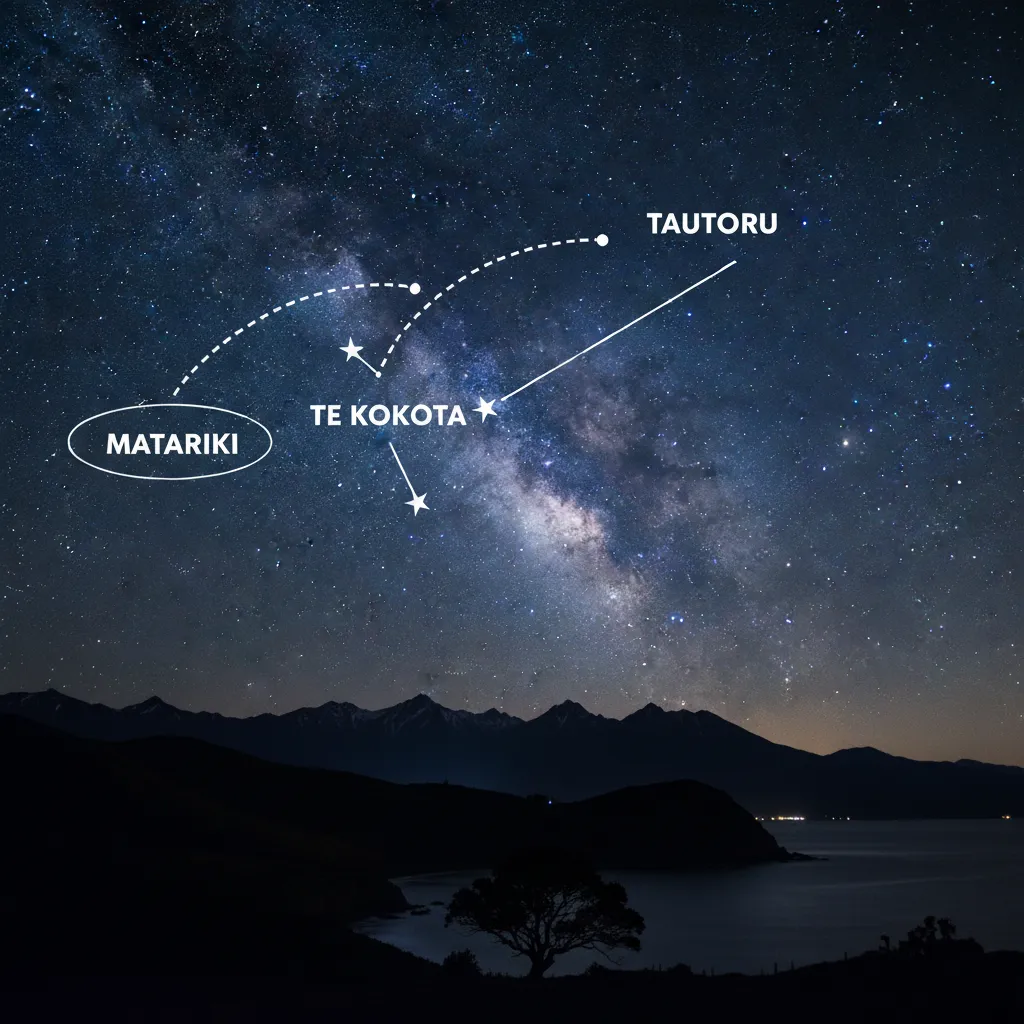
To find the Matariki cluster, face the northeast horizon between 5:30 AM and 6:30 AM during mid-winter. Locate the three stars of Tautoru (Orion’s Belt), trace a line leftward to the triangular cluster Te Kokota (Hyades), and continue extending that line to the left until you see the distinct, tight grouping of twinkling blue stars that is Matariki.
For observers in Aotearoa New Zealand, spotting the rise of Matariki signals the Māori New Year. While this star cluster—known globally as the Pleiades or Messier 45—is visible from many parts of the world, finding it in the pre-dawn winter sky requires specific timing and navigational knowledge. This guide provides an authoritative, step-by-step approach to locating the cluster using celestial wayfinding techniques, ensuring you can participate in this significant cultural and astronomical event.
How do I use Tautoru (Orion’s Belt) to find Matariki?
The most reliable method for locating Matariki is celestial navigation using prominent constellations as signposts. In the southern hemisphere winter sky, Tautoru (the three stars of Orion’s Belt) serves as the primary anchor for orientation.
Tautoru is unmistakable. It consists of three bright stars—Mintaka, Alnilam, and Alnitak—arranged in a near-perfect straight line. In the pre-dawn sky of June and July, Tautoru will appear almost vertical or slightly tilted in the northeastern quadrant of the sky. Once you have identified this formation, you have your starting point.
The Three-Step Star Hopping Method
To navigate from Tautoru to Matariki, follow this three-step visual progression:
- Locate Tautoru: Find the three bright stars of Orion’s Belt standing high in the northeast.
- Shift Left to Te Kokota (The Hyades): Trace an imaginary line from Tautoru towards the left (north). You will encounter a bright orange star named Aldebaran, which forms part of a V-shaped cluster. This is the face of Taurus the Bull, known in Māori astronomy as Te Kokota.
- Continue Left to Matariki: Keep following that same imaginary line past the V-shape of Te Kokota. Look for a smaller, tighter cluster of stars that glimmers like a diamond brooch. This is Matariki.
It is important to note that the distance from Tautoru to Te Kokota is roughly the same as the distance from Te Kokota to Matariki. This symmetry aids in confirmation; if you have scanned too far without seeing a distinct cluster, you may have overshot the mark.
Where should I look on the compass?
Precision is key when the sky is vast. Matariki rises in the northeast. If you have a compass or a smartphone app, you are looking for an azimuth of approximately 45 to 60 degrees, depending on your specific latitude in New Zealand and the exact date in June or July.
However, you do not need digital tools if you understand the landscape. The sun rises in the east (or slightly northeast in winter). Matariki rises ahead of the sun, following a similar track. Therefore, you should be facing the direction where the sun will eventually emerge. If you are facing south towards the Southern Cross, you are looking in the wrong direction.
Elevation Above the Horizon
Matariki does not sit high in the zenith (directly overhead) during the early morning hours of the New Year period. It sits relatively low on the horizon, typically between 15 and 30 degrees elevation depending on the time. This means you need a viewing location with a clear view of the northeastern horizon. Tall buildings, mountain ranges, or dense forests blocking the northeast view will make sighting the cluster impossible.

When is the best time to see Matariki?
Timing is the most critical variable in successful Matariki viewing. The cluster is heliacal, meaning it becomes visible just before sunrise after a period of being hidden by the sun’s glare. To see it, the sky must be dark enough for the stars to shine, but the cluster must have risen above the horizon.
The Pre-Dawn Window
The optimal viewing window is generally between 5:30 AM and 6:30 AM. If you look too early (e.g., 3:00 AM), the cluster may not have risen above the horizon yet. If you look too late (e.g., 7:00 AM), the rising sun’s light will drown out the faint stars of the cluster.
The Lunar Phase Connection (Tangaroa)
In Māori astronomy, the phase of the moon is just as important as the time of day. A full moon brightens the sky significantly, washing out the delicate light of Matariki. The most auspicious time for viewing is during the Tangaroa phases of the moon—the last quarter moon when the sky is darkest before dawn. This usually occurs in late June or early July.
Consult a local lunar calendar (maramataka) to identify the nights of Tangaroa-a-roto, Tangaroa-a-kiokio, and Tangaroa-whakapau. These mornings offer the highest contrast between the dark sky and the sparkling blue stars.
How to distinguish Matariki from other clusters?
Novice stargazers often confuse Matariki with other celestial objects. The most common error is confusing it with Te Kokota (the Hyades) or the Southern Cross. Here is how to ensure you are looking at the correct object.
Size and Compactness
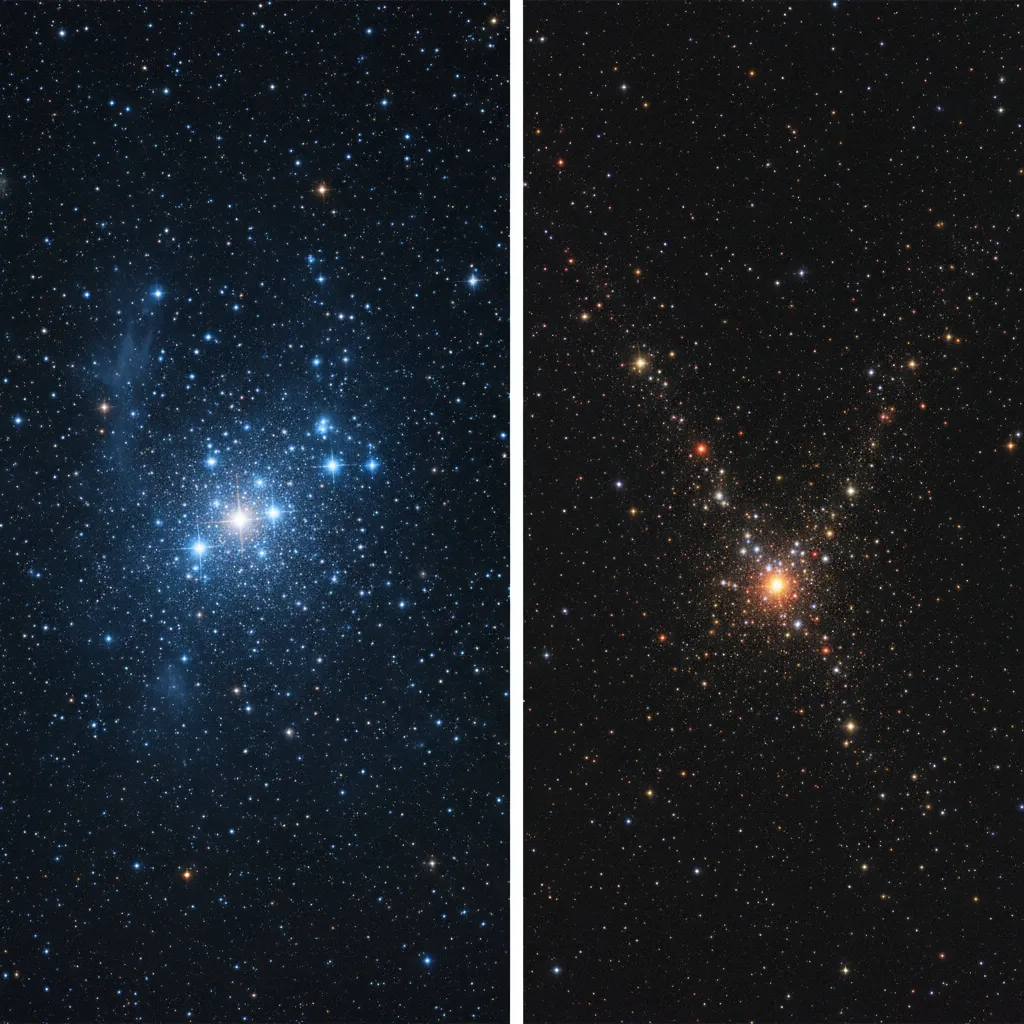
Matariki is an open star cluster, but from Earth, it appears very compact. It occupies a space in the sky roughly four times the size of the full moon, but the core stars are tight. In contrast, Te Kokota (Hyades) is much larger and spread out in a distinct ‘V’ shape. If the cluster looks like a large letter ‘V’, you are looking at the Hyades, not Matariki. Look further left.
Color and Twinkle
The stars of Matariki are hot, young, blue luminous stars. They have a distinct icy-blue hue. Te Kokota contains the bright star Aldebaran, which is a red giant and glows with an unmistakable orange light. If you see orange, you are not looking at Matariki.
Peripheral Vision Technique
Because the cluster is faint, looking directly at it can sometimes make it seem to disappear (a phenomenon caused by the blind spot in the center of the human eye). To see Matariki most clearly, look slightly to the side of the cluster. Your peripheral vision is more sensitive to low light, making the cluster appear brighter and more defined.
Where are the best places in NZ to view Matariki?
New Zealand is a world leader in Dark Sky tourism. To see the full cluster—often cited as seven stars, but actually containing hundreds, with nine typically identified in Māori tradition—you need minimal light pollution. City lights will often limit visibility to only the brightest 4 or 5 stars.
Aoraki Mackenzie International Dark Sky Reserve
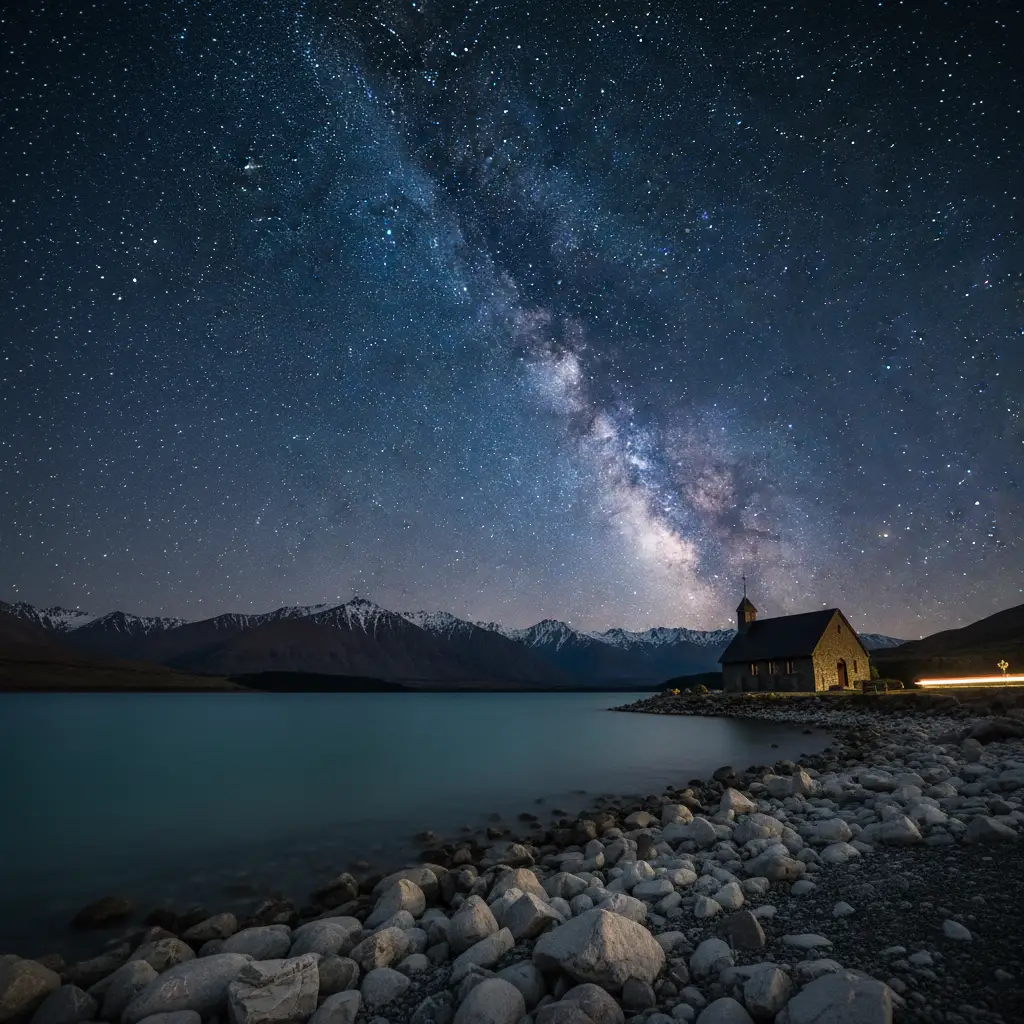
Located in the South Island, this is the gold standard for stargazing. Locations like Lake Tekapo and Mt. Cook Village offer Bortle Scale 1 skies (the darkest possible). Here, the Matariki cluster explodes with visibility, often allowing observers to see faint nebulosity around the stars with binoculars.
Great Barrier Island (Aotea)
As an International Dark Sky Sanctuary, Great Barrier Island near Auckland offers an accessible escape from city lights. Being an island, the ocean horizon is often flat and clear, providing excellent sightlines for the rising cluster in the northeast.
Rakiura (Stewart Island)
The southernmost Dark Sky Sanctuary in the world. While the weather can be challenging, a clear winter morning in Rakiura offers a pristine view of the cosmos unmatched by almost any other populated location on Earth.
Why is finding Matariki culturally significant?
Finding the cluster is not merely an astronomical exercise; it is a spiritual act of reconnection. In Māori tradition, the appearance of Matariki heralds the New Year (Te Mātahi o te Tau). It is a time to remember those who have passed since the last rising (Hunga Mate), celebrate the present (Hunga Ora), and plan for the future.
Each of the nine visible stars holds dominion over a specific environmental domain:
- Matariki: The mother star, signifying health and well-being.
- Pōhutukawa: Connected to those who have passed on.
- Tupuānuku: Connected to food grown in the ground (kumara, potatoes).
- Tupuārangi: Connected to food from the sky (birds, fruit).
- Waitī: Connected to fresh water and food within it.
- Waitā: Connected to the ocean and kai moana.
- Waipuna-ā-rangi: Connected to the rain.
- Ururangi: Connected to the winds.
- Hiwa-i-te-rangi: The wishing star, connected to our aspirations.
When you successfully locate the cluster, you are viewing a celestial calendar that has guided navigation, harvesting, and community life in the Pacific for centuries.
People Also Ask
How many stars are in the Matariki cluster?
While the cluster contains over 1,000 stars, only about 7 to 9 are visible to the naked eye under good conditions. In Māori tradition, 9 distinct stars are named and recognized, though seeing all 9 requires very dark skies and excellent eyesight.
Is Matariki the same as the Pleiades?
Yes, Matariki is the Māori name for the star cluster known internationally as the Pleiades (M45). It is also known as Subaru in Japan and the Seven Sisters in Greek mythology.
Can I see Matariki in the evening?
During the New Year period (June/July), Matariki is only visible in the early morning before dawn. In the summer months (December/January), the cluster is visible in the evening sky, but this does not mark the Māori New Year.
What equipment do I need to see Matariki?
You do not need a telescope. Matariki is best viewed with the naked eye or a pair of binoculars. A telescope often zooms in too far, making it difficult to see the entire cluster at once. 7×50 or 10×50 binoculars are ideal.
Why does Matariki disappear for part of the year?
Matariki disappears from view in roughly May due to the position of the Earth in its orbit around the Sun. During this time, the sun is between Earth and the cluster, rendering it invisible in the glare of daylight. Its reappearance in late June marks the New Year.
What if it is cloudy on the morning of Matariki?
If the horizon is cloudy, you may not see the cluster. However, the Matariki period lasts for several weeks. You can attempt to view the cluster on any clear morning during the Tangaroa lunar phases in June or July.