A printable Matariki scavenger hunt PDF is an educational resource designed to help children and families celebrate the Māori New Year by locating items that represent the nine stars of the Matariki cluster. These downloadable activities typically combine indoor and outdoor clues focused on nature, harvest, remembrance, and environmental connection, suitable for classrooms and home use.
The Significance of Matariki in Education
Matariki, the Māori name for the cluster of stars also known as the Pleiades, signals the Māori New Year. In New Zealand, this is a time of profound cultural significance, marked by remembrance of those who have passed (mate), celebrating the present harvest (kai), and planning for the future. For educators and parents, integrating a print Matariki scavenger hunt PDF into lesson plans or holiday activities is an exceptional way to engage tamariki (children) with these concepts interactively.
Unlike standard scavenger hunts that focus on random objects, a Matariki-themed hunt is deeply rooted in symbolism. Each item on the list should correspond to one of the nine stars in the cluster (Matariki, Pōhutukawa, Tupuānuku, Tupuārangi, Waitī, Waitā, Waipuna-ā-rangi, Ururangi, and Hiwa-i-te-rangi). By searching for items related to fresh water, salt water, wind, rain, and crops, children learn the distinct domain of each whetū (star).
Indoor Scavenger Hunt: Bringing the Stars Inside
Weather in June and July in Aotearoa can be unpredictable. Therefore, having a robust set of indoor clues is essential for any printable resource. These clues allow children to make connections between household items and the celestial bodies above.
Connecting Domestic Items to Celestial Concepts
When you prepare to print Matariki scavenger hunt pdf resources, ensure the indoor section focuses on representations. Here is a breakdown of how to structure indoor clues for maximum educational value:
- Tupuānuku (Food from the Earth): The clue should direct children to the pantry or vegetable bin.
Clue: “I am a star connected to food grown in the ground. Find a potato, a carrot, or a kūmara.” - Waitī (Fresh Water): This star watches over rivers and lakes.
Clue: “I look after the eels and the rivers. Find a glass of water or a picture of a waterfall.” - Waitā (Salt Water): This star represents the ocean and seafood.
Clue: “I am connected to the vast ocean. Find a seashell, some salt, or a toy fish.” - Waipuna-ā-rangi (Rain): This star is associated with rainfall.
Clue: “I bring the water from the sky to help plants grow. Find an umbrella or a raincoat.”
These activities turn a simple game into a lesson on the interconnectedness of our environment. Teachers can extend this by asking students to draw the item they found next to the star’s name on their worksheet.

Outdoor Exploration: Nature and Sky Clues
If the weather permits, taking the hunt outside connects learners directly with the taiao (environment). Matariki is fundamentally about environmental awareness, making an outdoor hunt the ideal way to celebrate.
Scavenging in the Backyard or School Grounds
The outdoor section of your print Matariki scavenger hunt pdf should encourage observation rather than just collection. We want to teach respect for nature, so “finding” might mean “spotting” rather than “picking.”
- Tupuārangi (Food from the Sky/Trees): This star connects to birds and berries.
Action: Spot a native bird (like a Tūī or Pīwakawaka) or find a tree with berries. Check it off your list. - Ururangi (The Winds): Associated with the mood of the winds.
Action: Find something that is moving because of the wind (a swaying branch, a flag, or leaves blowing on the ground). - Pōhutukawa (Remembrance): Connects to those who have passed on.
Action: Find a fallen leaf. This represents the cycle of life and returning to the earth. - Hiwa-i-te-rangi (The Wishing Star): The star to which we send our dreams for the new year.
Action: Find a spot where you can see the open sky clearly. Stand there and think of one wish for the coming year.
By engaging with these elements physically, the abstract concepts of Māori astronomy become tangible realities for learners. It grounds the spiritual aspects of the holiday in the physical world they interact with daily.
The 9 Stars Checklist: A Guide for Whānau
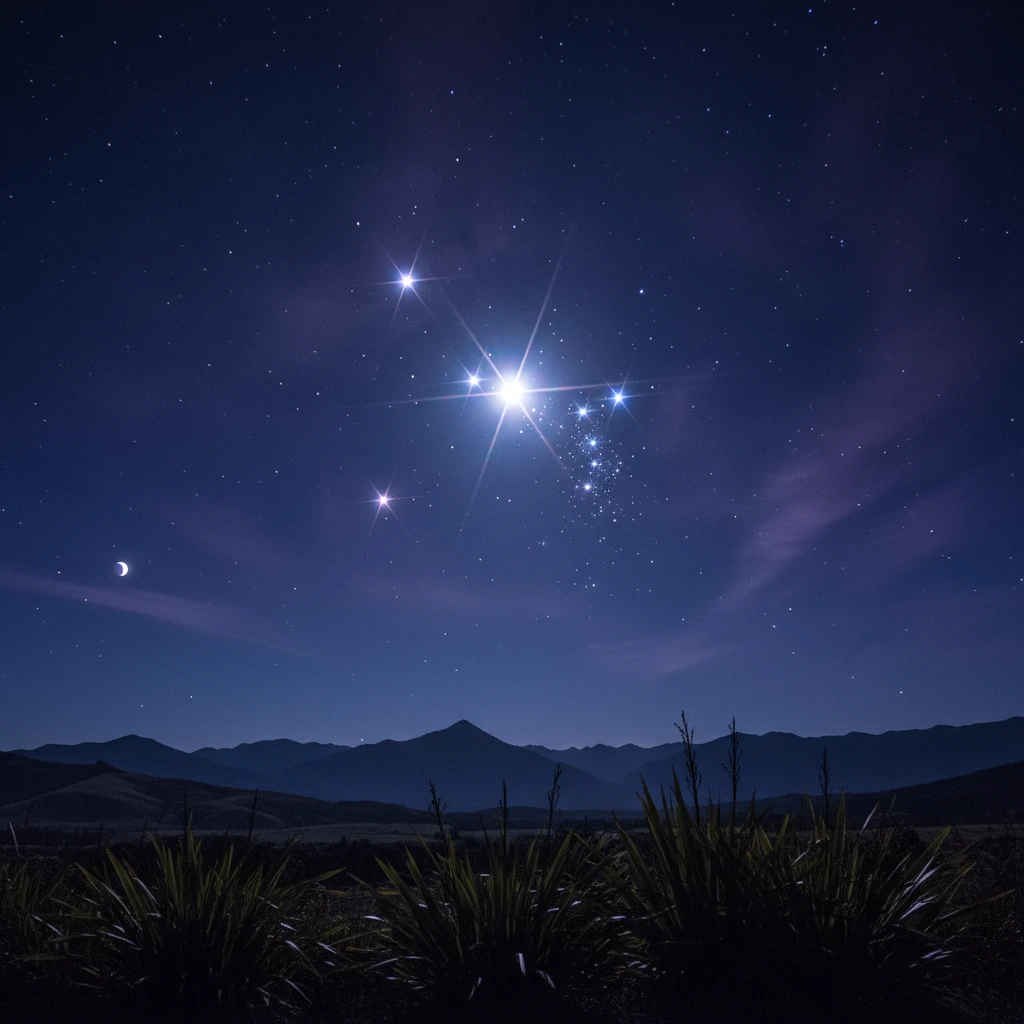
A comprehensive Matariki activity must include a specific checklist for the nine stars. While a general scavenger hunt looks for related items, a “Star-Finding Checklist” is a specific tool for stargazing. This is often best done in the early morning (pre-dawn) during the Matariki period.

How to Structure the Checklist
When you download the PDF, you will find a section dedicated to the visual identification of the cluster. Here is how to guide the search:
- Find Tautoru (Orion’s Belt): Look for the three bright stars in a row. This is the easiest anchor point in the winter sky.
- Follow the line: Trace a line to the left from Tautoru to find Te Kokotā (The Face of the Bull/Hyades).
- Keep going left: Continue that line to find the cluster of tiny twinkling stars. That is Matariki.
The checklist in the PDF includes checkboxes for visibility conditions. Since not all 9 stars are visible to the naked eye (usually only 7 are clear), the checklist encourages checking off the cluster and identifying the environmental domains surrounding you (e.g., “I can feel Ururangi/wind,” “I can see Tupuānuku/gardens”).
Instructions for Teachers and Parents
To maximize the impact of the print Matariki scavenger hunt pdf, educators and parents should follow a structured approach. Simply handing out the sheet is less effective than framing the activity with cultural context.
Pre-Activity Preparation
Before starting the hunt, hold a wānanga (learning session). Briefly explain the legend of Matariki. Explain that the stars are a family. Matariki is the mother, surrounded by her eight children. Each child has a job to do to help the earth.
During the Hunt
Encourage collaboration (mahi tahi). Pair older children with younger ones (tuakana-teina relationship). This reflects the communal nature of Matariki celebrations. If doing the outdoor hunt, remind children of the concept of kaitiakitanga (guardianship)—they are guardians of the nature they are exploring.
Post-Activity Reflection
Once the hunt is complete and the sheets are filled out, gather for a shared kai (food). Matariki is a time of feasting. Discuss what items were hardest to find and why. Use the “Hiwa-i-te-rangi” section of the hunt to have children share their hopes for the coming year aloud, fostering a supportive classroom or family environment.
Download Your Print Matariki Scavenger Hunt PDF
Below you will find the options for downloading the scavenger hunt resources. We have provided two versions to suit different printing capabilities and educational needs.
Option 1: Full Color Cultural Edition
This version features color-coded borders representing the different domains (blue for water stars, green for earth stars, purple for the wind/sky). It includes high-quality illustrations of the native birds and plants associated with the stars.
- Best for: Laminated classroom sets, family keepsakes, or digital viewing on tablets.
- Includes: 9-Star Checklist, Indoor/Outdoor Clues, Reflection Section.
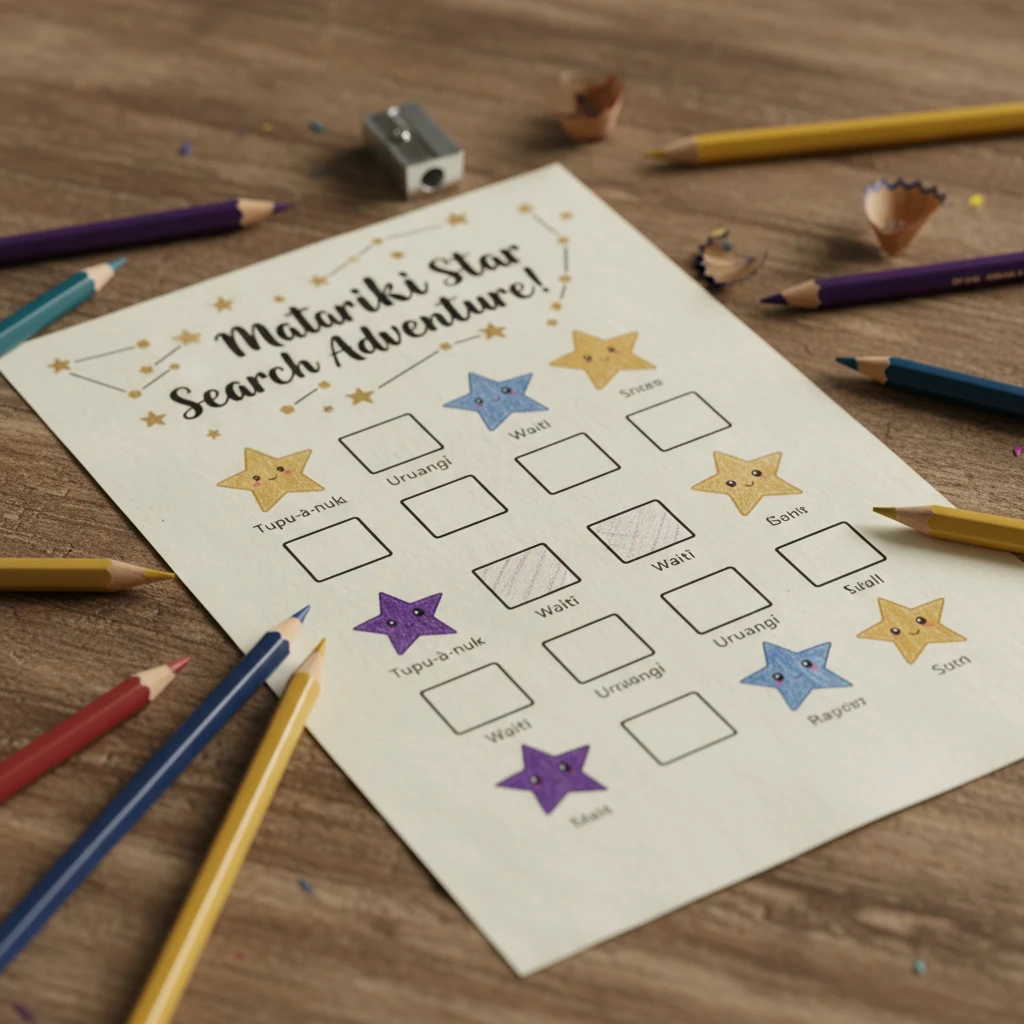
Option 2: Black & White Eco-Saver (Coloring Activity)
Designed for easy photocopying and saving ink. This version doubles as a coloring sheet. The illustrations are outlined so children can color in the stars and items (like the kūmara or eel) as they find them.
- Best for: Large classrooms, coloring activities, home printing.
- Includes: Coloring elements, Word search bonus on the back, Standard checklist.
Access the Files
Note: These are descriptive representations of the content found in the downloadable pack.
[DOWNLOAD: Matariki Scavenger Hunt – Full Color.pdf]
[DOWNLOAD: Matariki Scavenger Hunt – B&W Coloring.pdf]
[DOWNLOAD: Teacher’s Answer Key & Discussion Guide.pdf]
Tip: If you cannot print these immediately, you can copy the clue lists provided in the “Indoor” and “Outdoor” sections of this article onto a whiteboard or piece of paper to start the activity right away.
People Also Ask
What activities can you do for Matariki?
Popular Matariki activities include stargazing to find the cluster, sharing a hāngī or feast with whānau, planting trees or crops (gardening), weaving stars from flax (harakeke), and remembering loved ones who have passed away. Scavenger hunts and kite flying (manu tukutuku) are also traditional ways to celebrate the connection between earth and sky.
How do you explain Matariki to a child?
Explain Matariki as the Māori New Year, marked by a group of stars appearing in the winter sky. You can tell them it is a time for three things: remembering the past and people we miss, celebrating the present with good food and family, and planning for the future by making wishes to the star Hiwa-i-te-rangi.
What are the 9 stars of Matariki and their meanings?
The nine stars are: Matariki (well-being), Pōhutukawa (the dead), Tupuānuku (food from earth), Tupuārangi (food from sky/trees), Waitī (freshwater), Waitā (saltwater), Waipuna-ā-rangi (rain), Ururangi (wind), and Hiwa-i-te-rangi (wishing star). Each governs a specific environmental domain.
Is there a Matariki star for wishing?
Yes, the star Hiwa-i-te-rangi is known as the wishing star. It is the youngest star in the cluster, and Māori tradition involves sending your dreams and desires for the new year to this star, hoping they will come true.
What is the best time to see Matariki?
The best time to view Matariki is in the early morning, just before dawn, usually in June or July. You should look towards the north-east horizon. The cluster becomes visible during the lunar phase known as Tangaroa, the last quarter of the moon cycle.
How do I print a scavenger hunt from a PDF?
To print a scavenger hunt PDF, download the file to your computer or mobile device. Open it using a PDF reader like Adobe Acrobat or your browser’s built-in viewer. Select “File” > “Print.” Ensure you choose “Fit to Page” in the printer settings to ensure no clues are cut off, and select “Black and White” if you wish to save color ink.