To find true south using the Southern Cross, first locate the constellation Crux and the two bright “Pointer” stars (Alpha and Beta Centauri). Draw an imaginary line extending from the top star of the cross through the bottom star. Next, draw a perpendicular line starting from the midpoint between the two Pointer stars. The intersection of these two imaginary lines marks the South Celestial Pole. Dropping a vertical line from this intersection to the horizon identifies True South.
For centuries, explorers, navigators, and astronomers have looked to the night skies of the Southern Hemisphere for guidance. Unlike the Northern Hemisphere, which boasts a bright Polaris (North Star) to mark the pole, the southern sky lacks a singular, bright pole star. Instead, we rely on a specific constellation—Crux, commonly known as the Southern Cross—to derive our bearings. Mastering this skill is not only a rite of passage for outdoor enthusiasts in New Zealand but a critical safety skill for hikers, sailors, and aurora hunters.
In the context of Aotearoa (New Zealand), this celestial knowledge is deeply woven into Maramataka (the Māori lunar calendar) and the history of Polynesian wayfinding. Whether you are navigating the bush, sailing the coastline, or setting up a camera to capture the Aurora Australis, understanding how to read the southern sky is essential.
Identifying the Southern Cross (Crux)
Before you can navigate, you must positively identify the constellation. Crux is the smallest of the 88 modern constellations, yet it is one of the most distinct. It is circumpolar in New Zealand, meaning it never sets below the horizon for most of the country, appearing to rotate around the celestial pole throughout the night.
The Four Main Stars
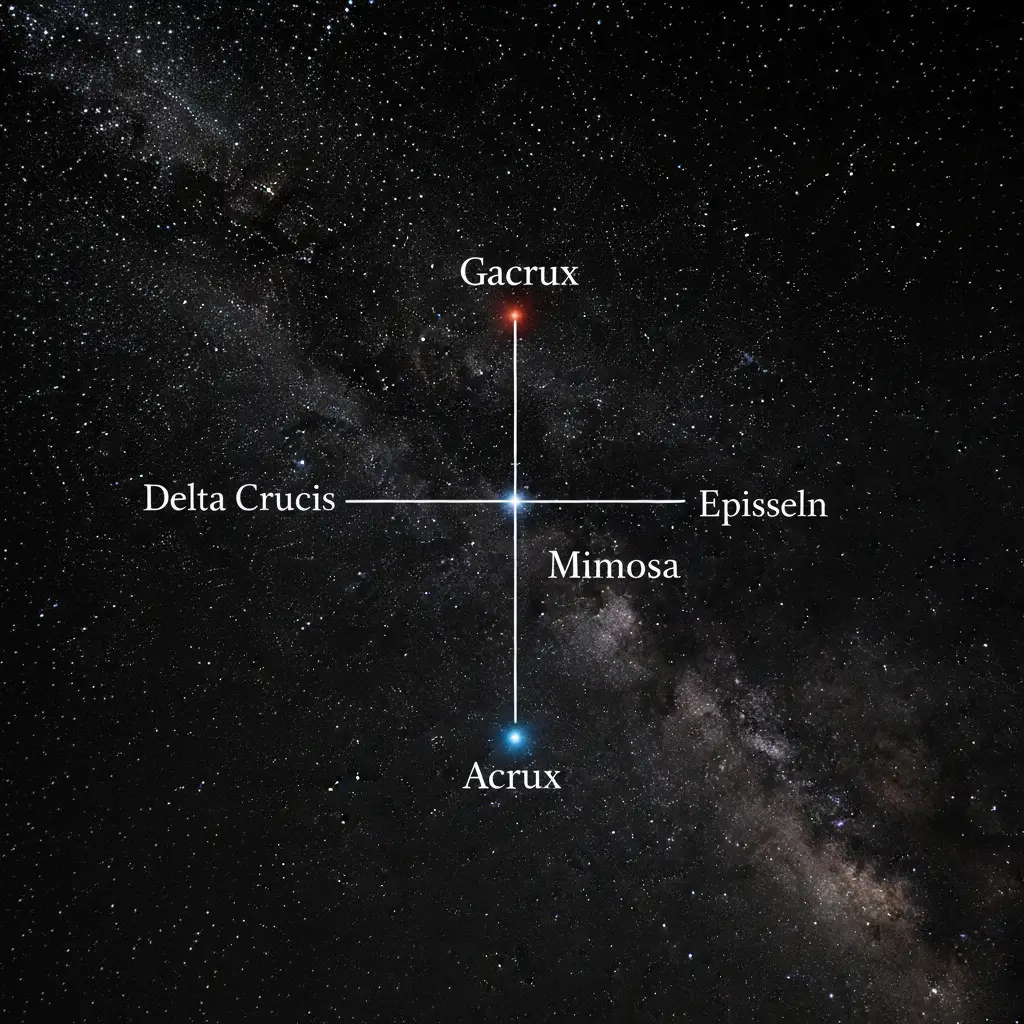
The cross is formed by four primary stars (and a faint fifth one often visible in dark skies):
- Acrux (Alpha Crucis): The brightest star, located at the bottom of the cross. It is actually a multiple star system roughly 320 light-years away.
- Mimosa (Beta Crucis): The second brightest, marking the left arm (eastern) of the cross.
- Gacrux (Gamma Crucis): The red giant star at the top of the cross. Its reddish hue is often visible to the naked eye and distinguishes it from the blue-white counterparts.
- Delta Crucis: The faintest of the four, marking the right arm (western).
Together, these stars form a kite-like asterism. However, the sky contains deceptive mimics, necessitating the use of the “Pointers” for confirmation.
Using the Pointers: Alpha & Beta Centauri
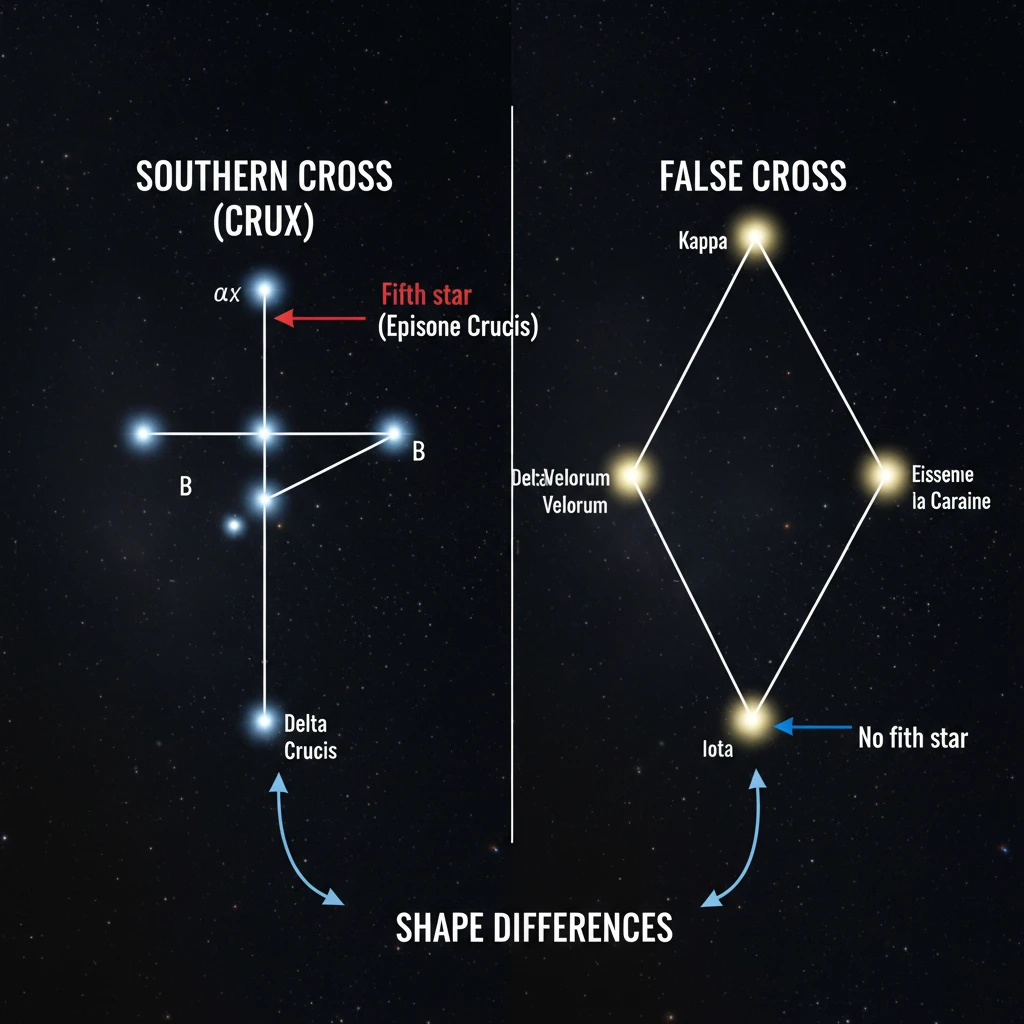
The most reliable way to confirm you are looking at the true Southern Cross, and not the “False Cross” (a larger asterism nearby formed by stars in Vela and Carina), is to locate the Pointers.
To the left (east) of the Southern Cross lie two very bright stars: Alpha Centauri and Beta Centauri. Alpha Centauri is the third brightest star in the night sky and our nearest star system. These two stars always “point” toward the top of the Southern Cross. If the stars you are looking at do not have two bright stars pointing at them, you are likely looking at the False Cross.

Geometric Methods for Finding South
Once you have identified the correct constellation, there are two primary geometric methods to locate the South Celestial Pole (SCP). The SCP is the point in the sky directly above the Earth’s geographic South Pole. Because there is no bright star there (only the faint Sigma Octantis), we must triangulate its position.
Method 1: The Intersection Method
This is the most accurate method for navigation:
- Extend the Cross: Imagine a line running from Gacrux (top star) through Acrux (bottom star). Extend this imaginary line out into the dark sky roughly 4.5 times the length of the cross itself.
- Bisect the Pointers: Draw a line connecting the two Pointer stars. Find the midpoint of this line and draw a perpendicular line (at a 90-degree angle) extending outwards.
- Find the Intersection: The point where the extended axis of the cross and the bisector of the pointers meet is the South Celestial Pole.
- Drop to Horizon: Look straight down from that intersection point to the horizon. That landmark is True South.
Method 2: The Extension Rule (4.5x Rule)
If the Pointers are obscured by clouds or terrain, you can use the dimensions of the cross itself. Take the distance between Gacrux and Acrux (the long axis). Replicate this distance approximately 4.5 times in the direction the cross is pointing. This will land you very close to the SCP.
The Diamond Method & Avoiding the False Cross
The term “Diamond” in celestial navigation often refers to distinguishing the shape of the true cross or utilizing the geometry of the surrounding stars.
Crux vs. The False Cross
The “False Cross” is larger, dimmer, and shaped more like a diamond than a kite. It is formed by the stars Avior, Aspidiske, Alsephina, and Markeb. The critical distinction is the central fifth star (Epsilon Crucis) present in the true Southern Cross (visible in dark NZ skies) and the presence of the Pointers. The False Cross has no pointers.
Triangulation via Achernar
Another method involving a large celestial “diamond” or triangle utilizes the bright star Achernar. Achernar is located roughly opposite the Southern Cross relative to the pole. If you can see both the Southern Cross and Achernar, the South Celestial Pole lies almost exactly halfway between the Southern Cross and Achernar. This creates a massive celestial span that helps verify your estimation derived from the intersection method.
Traditional Māori Navigation & Maramataka
In New Zealand, the night sky is not just a map; it is a cultural narrative. Māori navigators, among the greatest voyagers in human history, utilized these stars to cross the Pacific Ocean to Aotearoa.
Te Punga (The Anchor)
In Māori astronomy, the Southern Cross is often known as Māhutonga. However, in the context of the great waka (canoe) traditions, it acts as Te Punga—the anchor. The sky is perceived as a great waka (Te Waka o Tamarereti), where the tail of the Scorpion forms the prow and the Southern Cross forms the anchor hanging from the stern.
When Māhutonga is high in the sky, it signals specific seasonal changes within the Maramataka (Māori lunar calendar). For modern astronomy tourism in New Zealand, understanding these narratives adds immense value. It transforms a simple navigation lesson into a connection with the land’s history. When guiding tourists, referencing Māhutonga honors the indigenous knowledge that predates European sextants by centuries.

Application for Aurora Tourism
New Zealand is one of the world’s premier destinations for viewing the Aurora Australis (Southern Lights). Unlike the Northern Lights, which can often be seen overhead in high latitudes, the Southern Lights are frequently viewed on the southern horizon from the South Island (locations like Tekapo, Stewart Island, and the Catlins).
Why Finding South is Critical for Aurora Hunters
Auroras occur in an oval around the magnetic pole. From New Zealand, this activity appears on the southern horizon. Many amateur photographers miss the aurora simply because they are facing South-West or South-East. By using the Southern Cross to pinpoint True South, photographers can align their cameras perfectly to capture the pillars of light, even when they are faint to the naked eye.
Furthermore, composing a photograph with the Southern Cross directly above the Aurora Australis creates a quintessential New Zealand astrophotography image, blending the iconic constellation with the atmospheric phenomenon.
People Also Ask
Why does the Southern Cross move around the sky?
The Southern Cross is circumpolar in New Zealand, meaning it rotates around the South Celestial Pole due to the Earth’s rotation. While the pole remains fixed, the Cross swings around it like the hand of a clock (clockwise). At different times of the night and year, it may be upright, on its side, or upside down, but the relationship between the stars within it remains constant.
Can you see the Southern Cross from the Northern Hemisphere?
It is visible from tropical latitudes in the Northern Hemisphere (south of 25°N latitude) during certain times of the year, usually near the horizon. However, it is not visible from Europe, most of North America, or northern Asia. It is primarily a Southern Hemisphere constellation.
What is the difference between Magnetic South and True South?
True South is the direction toward the geographic South Pole (the axis of rotation). Magnetic South is the direction a compass needle points, which is influenced by the Earth’s magnetic field. In New Zealand, the magnetic declination (difference) is significant (roughly 20-25 degrees). Celestial navigation finds True South, which is more accurate for long-term orientation than an uncorrected compass.
How do I find South if the Southern Cross is too high or upside down?
The method remains the same regardless of orientation. Even if the cross is upside down (which happens in spring evenings in NZ), you still draw a line from the “top” star (Gacrux) through the “bottom” star (Acrux). The line just extends downwards toward the horizon in a different visual manner, but it always points to the SCP.
Is the Southern Cross on the New Zealand flag?
Yes, the New Zealand flag features four red stars with white borders, representing the Southern Cross. This highlights the constellation’s importance to the nation’s identity. The Australian flag also features the Southern Cross but includes five stars (adding the smaller Epsilon Crucis) and they are white.
What is the best time of year to see the Southern Cross in New Zealand?
The Southern Cross is visible year-round in New Zealand. However, it is highest in the evening sky during the autumn and winter months (April to August), which coincides with the best season for viewing the Aurora Australis due to longer nights.