
To spot Matariki (the Pleiades) in the pre-dawn sky, look toward the northeastern horizon between 5:30 AM and 6:30 AM. Locate the three stars of Orion’s Belt (Tautoru), draw an imaginary line leftwards through the bright orange star Taumata-kuku (Aldebaran), and continue until you find the tight cluster of twinkling stars.
For celestial navigators and cultural enthusiasts alike, the rising of Matariki marks a profound shift in the seasonal calendar. In Aotearoa New Zealand, this stellar event signals the Māori New Year, a time for remembrance, celebrating the present, and looking to the future. However, actually locating this relatively small star cluster requires specific timing, clear conditions, and a bit of navigational know-how. Unlike the bold brightness of Jupiter or the distinct shape of the Southern Cross, Matariki is subtle, requiring you to train your eyes on a specific patch of the northeastern horizon.
Whether you are an amateur astronomer seeking precise azimuth coordinates or a whānau looking to participate in a traditional hautapu ceremony, understanding exactly where to look is the first step. This guide provides a comprehensive breakdown of how to navigate the winter sky to find the “eyes of god.”
How Do You Find Matariki Using Orion’s Belt?
The most reliable method for spotting Matariki without digital tools is star hopping. This ancient technique utilizes prominent, easy-to-find constellations to guide your eye toward fainter celestial objects. For Matariki, your primary anchor is the constellation Orion, known in New Zealand as ‘The Pot’ or Tautoru.
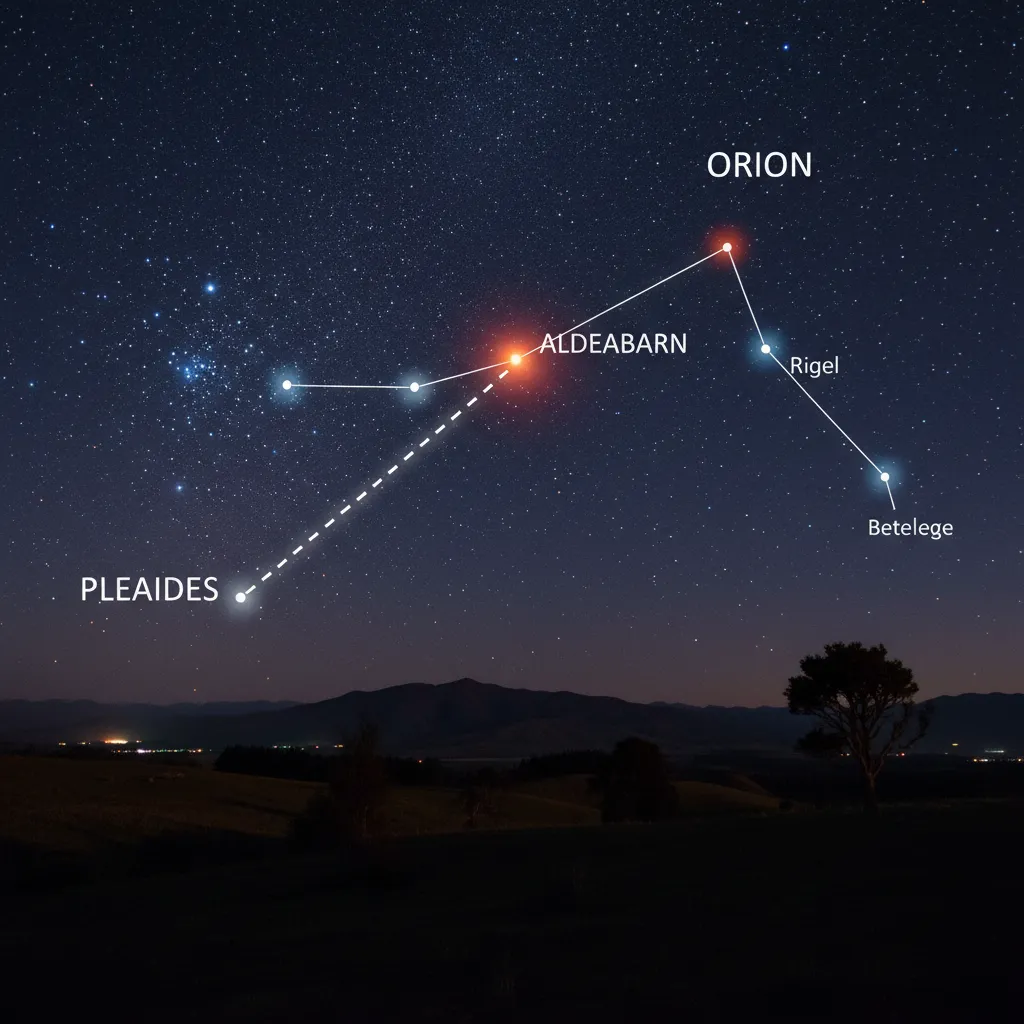
Locating Tautoru (The Three)
In the pre-dawn winter sky of the Southern Hemisphere, look directly Northeast. You will see three distinctive stars in a vertical row. This is Tautoru, or Orion’s Belt. These stars form the bottom of ‘The Pot.’ Because they are bright and geometrically distinct, they serve as the perfect starting point for your navigation.
The Pathway Through Taumata-kuku
Once you have fixed your eyes on Tautoru, imagine a line extending from the belt towards the left (North). Follow this trajectory until you hit a very bright, reddish-orange star. This is Taumata-kuku (Aldebaran), the fiery eye of the Bull in the Taurus constellation. It is often part of a V-shaped group of stars known as the Hyades (Te Kokota).
Do not stop at the orange star. Continue your imaginary line from Tautoru, through Taumata-kuku, and keep going to the left. Shortly after passing the Hyades, you will encounter a small, shimmering cluster of stars that looks somewhat like a miniature version of the Little Dipper or a fuzzy diamond patch. That cluster is Matariki.
What Are the Exact Coordinates for Matariki?
For those using telescopes, binoculars with compasses, or seeking a more technical approach to astrophotography, relying on visual cues might not be precise enough. Understanding the celestial coordinates—specifically Azimuth and Altitude—can help you position your equipment perfectly before the stars even break the horizon.
Understanding Azimuth and Altitude
Azimuth refers to the cardinal direction along the horizon, measured in degrees. North is 0° (or 360°), East is 90°, South is 180°, and West is 270°.
Altitude refers to the height of the object above the horizon, measured in degrees. The horizon is 0°, and directly overhead (the zenith) is 90°.
Target Coordinates for New Zealand (June/July)
While the exact position shifts slightly depending on your specific latitude in New Zealand (e.g., Auckland vs. Dunedin) and the specific date, the following coordinates are a reliable baseline for the Matariki rising period in mid-winter:
- Azimuth: Look between 45° and 60°. This places the cluster in the North-East (NE) sector of the sky. If you have a compass, orient yourself toward 50° NE.
- Altitude: Matariki sits relatively low on the horizon during the prime viewing hours. Look for an altitude between 10° and 20°. A helpful trick to estimate degrees is using your hand: held at arm’s length, the width of your pinky finger is roughly 1°, and the width of your fist is approximately 10°. Therefore, Matariki will be roughly one to two “fists” above the true horizon.

Using Digital Tools
Modern technology has simplified the hunt for Matariki. Apps like Stellarium, Star Walk 2, or SkyView allow you to input “Pleiades” or “Matariki” into the search bar. By using your phone’s gyroscope and GPS, these apps will guide you via an on-screen arrow to the exact coordinates (Right Ascension: 3h 47m, Declination: +24° 07′). However, ensure you use “Night Mode” (red screen) on these apps to preserve your dark adaptation.
When Is the Best Time to View Matariki?
Timing is critical. If you look too early, the cluster may not have risen above the horizon. If you look too late, the light of the sun (Te Rā) will drown out the faint twinkle of the sisters. The window of opportunity is narrow.
The Pre-Dawn Window (Pipiri)
The optimal time to view Matariki is during the period known as Pipiri, specifically in the last hour before sunrise. In New Zealand during June and July, this typically falls between 5:30 AM and 6:30 AM.
You need the sky to be dark enough to see the magnitude 1.6 brightness of the brightest stars in the cluster, but the cluster needs to be high enough to clear terrestrial obstacles like hills or trees. The sweet spot is usually about 45 minutes before the official sunrise time for your location.
The Lunar Phase Connection (Tangaroa)
In Māori astronomy, the visibility of Matariki is closely tied to the Maramataka (the Māori lunar calendar). The rising of Matariki is best observed during the Tangaroa moon phases—the last quarter of the moon cycle. During this time, the moon is less bright and rises later or sets earlier, leaving the pre-dawn sky darker. A full moon can wash out the sky, making it incredibly difficult to spot the subtle cluster. Always check the lunar phase; a dark, moonless sky is your best ally.

What Are Common Mistakes When Searching for Matariki?
Even with the right coordinates, many sky gazers fail to spot the cluster on their first attempt. The expectation often differs from reality, leading to confusion.
Mistaking It for the Southern Cross
A frequent error is looking in the wrong cardinal direction. The Southern Cross (Crux) is high in the southern sky. Matariki is in the northeast. If you are looking south, you are looking away from the new year.
Confusing Matariki with Jupiter or Sirius
Beginners often look for the brightest object in the sky. In the morning sky, the planet Jupiter or the star Sirius can be dazzlingly bright. Matariki is not a single bright star; it is a cluster. If you are focusing on one singular, bright point of light, you have likely found a planet or a different star. You are looking for a “group” or a “cloud” of stars.
Ignoring Light Pollution
Matariki is distinct but delicate. Streetlights, house lights, and urban glow (skyglow) can render it invisible. To successfully spot it, you must find a location with a dark northeastern horizon. Coastal areas facing east are often ideal as the ocean provides a flat, dark horizon line free of artificial light.
What Equipment Do You Need?
While Matariki is visible to the naked eye, enhancing your view can provide a deeper appreciation of the cluster’s beauty.
Binoculars vs. Telescopes
Contrary to popular belief, binoculars are often better than telescopes for viewing Matariki. Because the cluster covers a relatively wide area of the sky (about four times the width of the full moon), a telescope with high magnification might zoom in too far, showing only one or two stars at a time. A pair of 7×50 or 10×50 binoculars offers a wide field of view, allowing you to see the entire cluster framed beautifully against the dark sky.

Warm Clothing
This cannot be overstated: Matariki viewing happens in the dead of winter, before dawn. Temperatures are often near or below freezing. Layering is essential. Wear thermal base layers, a windproof outer shell, gloves, and a beanie. The colder you are, the less steady your hands will be holding binoculars, and the less patience you will have to scan the horizon.
People Also Ask
Which direction do I look for Matariki?
You must look toward the Northeast horizon. The cluster rises in the same general direction as the sun but appears about an hour before sunrise. A compass bearing of approximately 50 to 60 degrees is ideal.
Can I see Matariki with the naked eye?
Yes, Matariki is visible to the naked eye, provided you are in a location with low light pollution and clear skies. It appears as a fuzzy patch or a small group of tightly packed stars. However, binoculars reveal many more stars within the cluster.
How many stars are in the Matariki cluster?
While the cluster contains hundreds of stars, usually only seven to nine are visible to the naked eye. In Māori tradition, there are nine distinct stars: Matariki, Pōhutukawa, Tupuānuku, Tupuārangi, Waipunarangi, Waitī, Waitā, Ururangi, and Hiwa-i-te-rangi.
What date is best to see Matariki in 2024/2025?
The dates shift slightly each year based on the lunar calendar. Generally, the best viewing period is in late June or early July, specifically during the Tangaroa moon phase (last quarter) when the sky is darkest before dawn.
Why does Matariki twinkle so much?
Matariki appears low on the horizon when it first rises. Starlight has to pass through more of the Earth’s atmosphere when objects are low, causing turbulence that makes the stars appear to twinkle or flash rapidly. This twinkling was traditionally read as a sign of the coming weather.
Is Matariki the same as the Pleiades?
Yes, Matariki is the Māori name for the open star cluster known internationally as the Pleiades, or Messier 45 (M45). It is also known as Subaru in Japan and the Seven Sisters in Greek mythology.