
To find Puanga (Rigel), look toward the eastern horizon approximately one hour before sunrise during mid-winter (June/July). First, identify Tautoru (The Pot or Orion’s Belt), which appears as three bright stars in a vertical row. Look directly above this line to locate the brightest blue-white star in the immediate vicinity. Unlike the Matariki cluster, Puanga is a singular, brilliant point of light.
For many iwi (tribes) across Aotearoa New Zealand, particularly those on the West Coast and in the Far North, the rise of Puanga heralds the Māori New Year. While Matariki is the most widely recognized signifier, local geography often obscures the view of the Pleiades cluster, making the brilliant beacon of Puanga—known astronomically as Rigel—the primary celestial marker. Understanding how to locate this star is not merely an exercise in astronomy; it is a step toward connecting with the deep cultural rhythms of the land and the season of wānanga (learning, which can be explored creatively using Maori Art Supplies).
What is the Puanga Star?
Puanga is known in Western astronomy as Rigel (Beta Orionis). It is a blue-white supergiant star located in the constellation of Orion. It is one of the brightest stars in the night sky, significantly outshining the individual stars found within the Matariki (Pleiades) cluster, a grouping often linked to Ngā Mata o te Ariki: The Eyes of the God. Because of its intense luminosity and position higher in the sky relative to Matariki, it is often easier to spot, especially in areas with mountainous terrain to the east.
In Māori cosmology, Puanga is often viewed as the older brother of Matariki. There is a saying, “Puanga kai rau” (Puanga of the abundant harvest), which refers to the star’s role in signaling the time to store crops and prepare for the winter months. While Matariki is a cluster of stars, Puanga stands alone as a singular, powerful guardian of the winter sky.

How to Find Puanga Star: Step-by-Step Guide
Locating Puanga requires no special equipment, though a clear view of the eastern horizon is essential. The process relies on star-hopping, using prominent constellations to guide your eye to the target.
1. Face the Eastern Horizon
During the months of June and July, the celestial signs for the Māori New Year appear in the East. You must position yourself facing the direction where the sun will eventually rise. It is crucial to be in position well before dawn, as the rising sun will quickly bleach the stars from the sky.
2. Locate Tautoru (The Pot / Orion’s Belt)
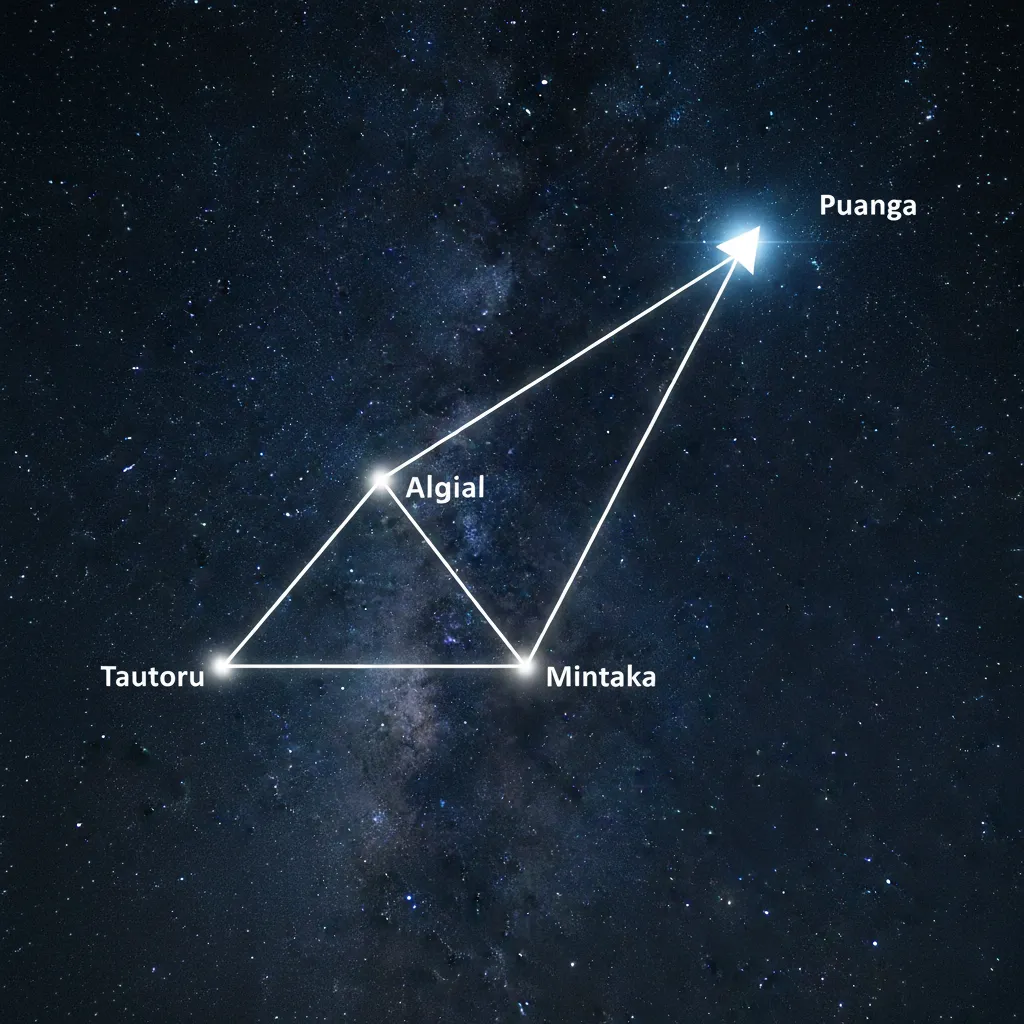
The most reliable anchor for finding Puanga is the constellation known to Māori as Tautoru, and to Western observers as Orion’s Belt or “The Pot.” In the Southern Hemisphere, Orion appears upside down compared to the Northern Hemisphere view.
Look for three distinct, bright stars arranged in a near-perfect vertical line. This is the bottom of “The Pot.” Angling away from these three stars are fainter stars that form the handle of the pot. These three belt stars are unmistakable and serve as the central signpost for the winter sky.
3. Identify Puanga Above the Belt
Once you have fixed your eyes on the three stars of Tautoru, look upward and slightly to the left (depending on the exact time of morning). You are looking for a very bright, solitary star. This is Puanga.
If you were to look below the belt, you would see a reddish star known as Betelgeuse. Ensure you are looking above the belt for the blue-white diamond brilliance of Rigel/Puanga.
Distinguishing Puanga vs. Matariki
A common source of confusion for novice sky-watchers is distinguishing between Puanga and Matariki. While they are physically relatively close to each other in the sky, their visual characteristics are distinct. To see these spatial relationships, utilizing an Interactive Night Sky Map Tool: Locate Matariki Now can be very helpful.
The Visual Difference
Matariki is a star cluster (The Pleiades). When viewed with the naked eye, it does not look like a single sharp point of light. Instead, it resembles a fuzzy patch, a small cloud, or a “pile of rocks.” People with sharp vision can distinguish roughly seven to nine individual stars within the cluster, but the overall impression is that of a group.
Puanga, conversely, is a single star. It is sharp, piercing, and defined. It does not twinkle as erratically as Sirius (which is much lower and to the right), but it shines with a steady, intense blue-white light. It is approximately 40,000 times more luminous than our Sun, which helps it cut through light pollution or atmospheric haze better than the fainter Matariki cluster.
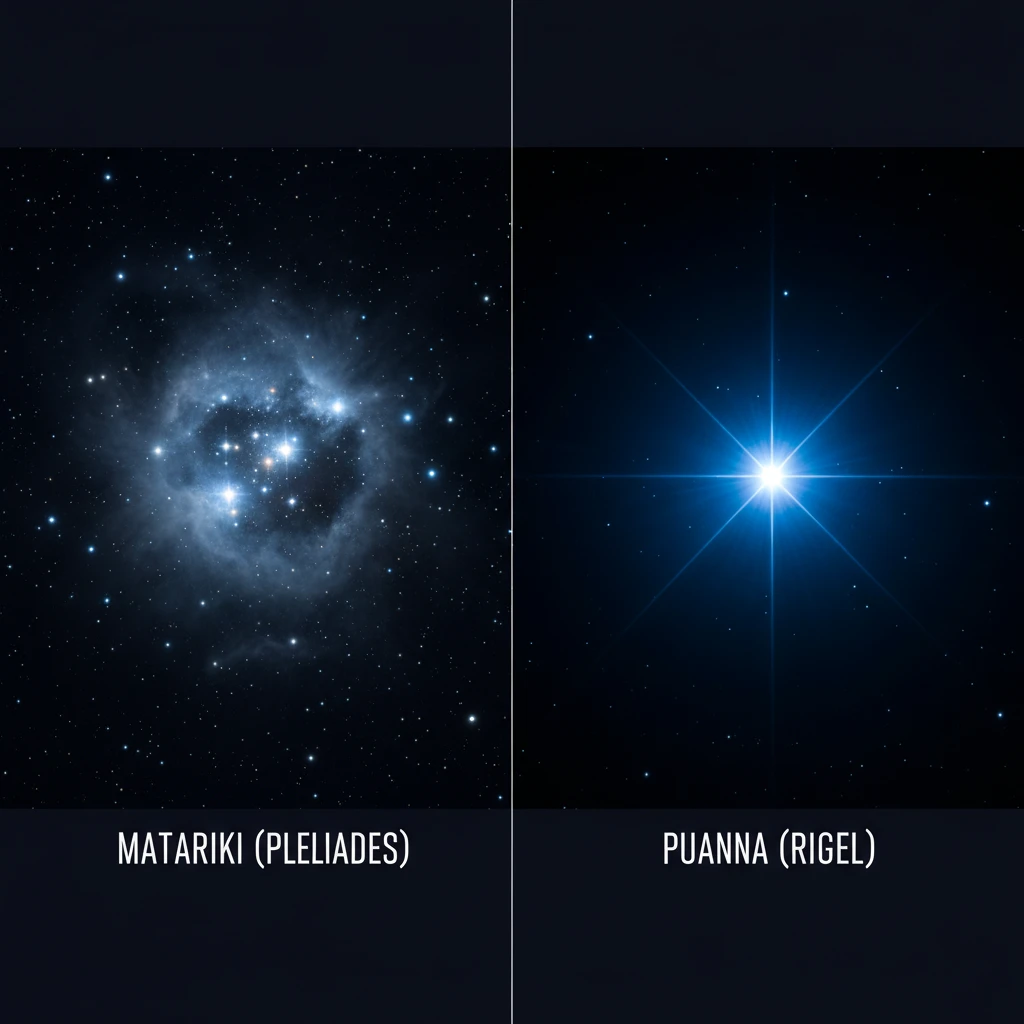
Positional Relationship
To confirm you are seeing both:
- Find Tautoru (The Pot).
- Look above Tautoru to find Puanga.
- Look to the left (Northward) of Tautoru to find Matariki.
If you imagine a line drawn from Tautoru to the left, you will first pass the bright orange star Taumata-kuku (Aldebaran) in the shape of a ‘V’ (The Hyades), and continuing past that line leads you to the cluster of Matariki.
Using Tautoru (The Pot) as a Celestial Pointer
Tautoru is the master key to the winter sky in Aotearoa. Understanding its orientation is vital for successful navigation. Tautoru is part of the larger constellation known as Te Kakau (The Handle), which corresponds to Orion.
The three stars of the belt are named (from top to bottom in the Southern view): Mintaka, Alnilam, and Alnitak. However, you do not need to memorize these names to use them as a tool. You simply need to recognize the geometry.
Think of Tautoru as an arrow. The “handle” of the pot (the sword of Orion) points away from the belt. The belt itself acts as a dividing line. The bright star on the “upper” side of the divider is always Puanga. The bright star on the “lower” side is Betelgeuse. By strictly adhering to the rule of “Above the Belt,” you eliminate the risk of identifying the wrong star.
Best Time and Conditions for Viewing
Successful astronomical observation requires timing, patience, and the right environment. Finding Puanga is no exception.
The Pre-Dawn Window
The optimal time to view Puanga is in the pre-dawn hours, known as Te Ata Hapara (the time when the sky begins to lighten). Specifically, you should aim to be observing between 5:30 AM and 6:30 AM during June and July. If you wait until 7:00 AM, the sun’s ambient light will likely be too strong, washing out the stars.
Optimal Locations
While Puanga is bright enough to be seen from suburban backyards, light pollution from streetlamps can diminish the experience. For the best viewing:
- Move away from city centers: Travel to a rural location or a designated Dark Sky Sanctuary.
- Find high ground: Getting above the low-lying mist or fog is helpful.
- Clear Eastern view: Ensure there are no tall buildings or dense tree lines blocking the eastern horizon.
Equipment Recommendations
One of the beauties of the Māori New Year observation is that it is traditionally a naked-eye event. You do not need a telescope. In fact, a high-powered telescope might zoom in too far, making it difficult to understand the relationship between the constellations. However, a pair of standard binoculars (e.g., 7×50 or 10×50) can be wonderful for resolving the colors of the stars and seeing the density of the Matariki cluster once you have located Puanga.
Common Mistakes in Identification
Even with a guide, the night sky can be overwhelming. Here are the most frequent errors observers make when trying to find Puanga.
Confusing Sirius (Takurua) with Puanga
Sirius is the brightest star in the entire night sky and is located to the right and lower down from Orion. Because it is so bright and often twinkles with flashes of color, it draws the eye. Remember: Puanga is above the belt of Tautoru. Sirius is below and to the right, following the line of the belt downwards.
Looking Too Low on the Horizon
By mid-winter, Puanga rises reasonably high in the sky before dawn. If you are scanning the very edge of the horizon, you might be looking too low. Lift your gaze to about 20 to 30 degrees above the horizon (roughly two to three fist-widths held at arm’s length).
Confusing Betelgeuse with Puanga
As mentioned, Betelgeuse is on the opposite side of the belt. The easiest way to tell them apart is color. Betelgeuse is a Red Supergiant and has a distinct orange-red tint. Puanga (Rigel) is a Blue Supergiant and appears blue-white. If the star looks reddish, you are looking at the wrong side of the Pot.

The Cultural Significance of Puanga
Understanding how to find the star is enriched by understanding why we look for it. In regions like Taranaki, Whanganui, parts of the Far North, and the West Coast of the South Island, Matariki appears very low on the horizon or is obscured by mountain ranges (such as Mount Taranaki or the Southern Alps).
For iwi in these areas, Puanga is the primary tohu (sign) for the New Year. The brightness of Puanga was also used to predict the upcoming season. If the star appeared clear and bright, it signaled a warm growing season and a plentiful harvest. If the star appeared hazy or shimmering (due to atmospheric turbulence), it was interpreted as a sign of a cold, difficult winter and a lean harvest.
This variation in observation highlights the localized nature of Māori astronomy. It is not a “one size fits all” system but rather one deeply attuned to the specific landscape and environment of the observer. By learning to find Puanga, you are participating in a tradition of environmental observation that has sustained people in Aotearoa for centuries.
Frequently Asked Questions
Is Puanga the same as Matariki?
No, they are different celestial bodies. Puanga is a single bright star (Rigel) in the Orion constellation. Matariki is a star cluster (The Pleiades) located in the Taurus constellation. They rise around the same time, but Puanga is used as the New Year marker by tribes who cannot clearly see Matariki due to geography.
What is the English name for Puanga?
The English/scientific name for Puanga is Rigel (Beta Orionis). It is the brightest star in the Orion constellation and the seventh-brightest star in the night sky.
Where do I look for Puanga?
Look towards the Eastern horizon before dawn. Find the three bright stars of “The Pot” (Orion’s Belt). Puanga is the bright blue-white star located directly above these three stars.
Why do some iwi celebrate Puanga instead of Matariki?
Iwi in the West Coast, Taranaki, and Whanganui regions often celebrate Puanga because high mountain ranges block the view of the lower-rising Matariki cluster. Puanga rises higher and is brighter, making it a more reliable marker in these specific locations.
Can you see Puanga with the naked eye?
Yes, absolutely. Puanga is one of the brightest stars in the sky. It is easily visible to the naked eye, even in areas with mild light pollution, provided you are looking in the correct direction before sunrise.
When does Puanga rise?
Puanga becomes visible in the pre-dawn sky in late May or early June. However, the celebration of the New Year usually coincides with the lunar phase (Tangaroa moon phases) in June or July, when the star is prominent in the eastern sky before the sun rises.