
Puanga is the Māori name for the star Rigel in the constellation Orion. For iwi in Taranaki, Whanganui, parts of the Far North and the South Island, Puanga rather than Matariki signals the beginning of the Māori New Year. In these regions the Matariki star cluster is hard to see clearly, so iwi place importance on Puanga, which is easier to see in twilight. The star has been observed and celebrated by these communities for generations, and in recent years Puanga traditions have gained wider recognition across Aotearoa.
Why some iwi celebrate Puanga instead of Matariki
Iwi and hapū along the west coast, including those from Taranaki, Whanganui, Ruapehu and Rangitīkei, mark the new year with Puanga. Iwi who follow Puanga often live in areas where the eastern horizon is obscured by maunga, forests or fog, while Puanga is a bright star making it easier to spot in poor visibility or through mist.
The focus on Puanga rather than Matariki is based on location and weather, and after centuries of observation tūpuna worked out that Puanga gives a more reliable long term forecast to help with annual food gathering and preparation in the area from Taranaki to the central volcanos and south along the central ranges.
Most of these iwi still acknowledge Matariki too, but celebrate and honour Puanga as a reclamation of iwi and hapū-specific mātauranga. Different iwi have different names for the star. Puanga is known to some northern iwi as Puangarua, while Ngāi Tahu in the South Island call the star Puaka.
Finding Puanga in the night sky
Puanga, or Rigel, is the seventh brightest star in the sky. While it is visible throughout the year, Puanga becomes especially prominent in the evening sky towards the end of autumn and in the predawn sky during the first month of the new year.
To find Puanga, look for Tautoru, the three stars of Orion’s Belt, also known as the Pot. Above the pot you will find a bright star called Puanga. In the late autumn and early winter night sky Matariki is seen below Puanga and to the left of Tautoru. You can find more tips in our stargazing guide.
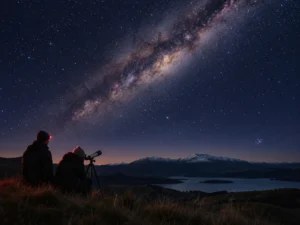
Puanga and Matariki together
Puanga features in the sky just prior to Matariki and is seen as a precursor to Matariki for the tribes that cannot see Matariki in the east, and for Whanganui and Taranaki tribes Puanga is the significant star to celebrate the New Year. Professor Rangi Mātāmua notes that the variation in the rising between Matariki and Puanga is very small.
Matariki mā Puanga was selected as the theme for the fourth Matariki public holiday in 2025. The theme recognised the richness of regional diversity in marking the Māori New Year. Te Papa and other institutions now celebrate the rising of Matariki and Puanga in their programmes.
Celebrating Puanga in Taranaki and Whanganui
In Whanganui, Ngāti Rangi and other iwi of the awa have long observed Puanga, holding dawn ceremonies at marae and atop maunga to mark its rising, while in Taranaki Puanga has always been the focus as their own celestial marker of transition and renewal.
Ngāti Rangi gather on Mt Ruapehu to celebrate Puanga, and kaumātua Che Wilson explains that in the old days during the cold times Ngāti Rangi would embark on the Whanganui River where they would stay to see the rise of Matariki, but they saw Puanga instead, so they look to Puanga and those stars are the ones who guide them. Like Matariki, Puanga is a time to reflect on the past and plan for and celebrate the year ahead.
Many communities in Taranaki and Manawatū-Whanganui now hold Puanga festivals and celebrations. Check the events calendar closer to the time for specific details, and see our Puanga festival guide for more about regional celebrations.
Traditional knowledge and practices
The Māori New Year starts with the new moon of the first month of the cold season, Pipiri, the month when people started to come together or to piri back at the main settlement after living in the various food gathering sites during summer and autumn in preparation for the cold months ahead.
The appearance of Puanga signalled the New Year in traditional times when the harvest was in and food had been stored, and a harvest festival would take place with a large hākari. The rising of Puanga was a time for communities to gather, remember those who had passed, and prepare for the year ahead.
Matariki and Puanga are both part of Te Waka o Rangi, the waka that carries the souls of those who passed away during the previous year, with Matariki at the front of the waka and Puanga along with Tautoru at the stern. You can read more about remembrance traditions in our guide on remembering the dead.
Puanga in storytelling and mātauranga Māori
Puanga appears in traditional stories and knowledge systems. Puawānanga, the clematis plant, was said to be the child of the stars Puanga and Rehua, and in some traditions the appearance of Puanga signalled winter and Rehua summer, with puawānanga trees flowering in the months between them.
In Māori mythology Puanga was believed to be the older brother of Matariki. Puanga is often grouped together with Puanga Hori (Procyon) and Whakaahu (Castor) under the name Puanganui-o-te-rangi.
Participating respectfully
If you are attending Puanga events or dawn gatherings, follow the guidance of local iwi and event organisers. Each community has its own tikanga and ways of observing Puanga. Our guide on participating respectfully offers general guidance for attending Māori New Year events.
Schools and workplaces can acknowledge both Matariki and Puanga when marking the Māori New Year. See our guides for lesson plans and celebrating at work for ideas that respect different iwi traditions.
Sources
- Te Ara – Puanga o te Rangi
- Te Papa – How to find the Matariki star cluster
- Te Ara – Matariki: Te Tau Hou Māori
- RNZ – Puanga to take starring role at Matariki celebrations

Independent Matariki guides from 0 Digital, Aotearoa New Zealand, researched from published sources and checked with care. Details change, so check with the operator or the official source before you go. Spotted something out of date? Tell us.
 The stars
 The stars
 The stars