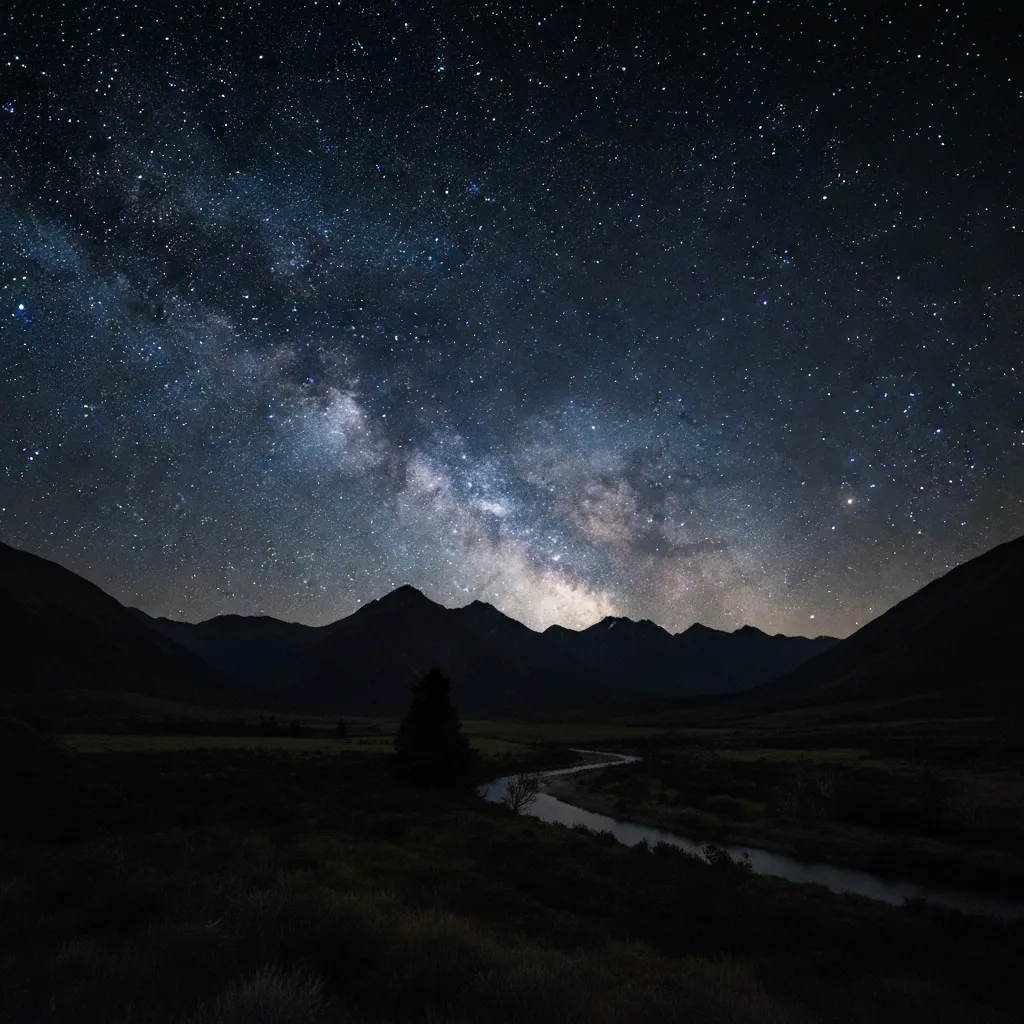
To find Matariki without a telescope, look toward the north-eastern horizon approximately 30 to 60 minutes before sunrise. Locate the three distinct stars of Tautoru (Orion’s Belt) and follow a straight line to the left. Your gaze will pass through the triangular cluster of Taumata-kuku (Aldebaran) before reaching the distinct cluster of tiny, twinkling stars known as Matariki.
Matariki, known internationally as the Pleiades or the Seven Sisters, marks the beginning of the Māori New Year. It is an event of profound cultural significance in Aotearoa New Zealand, signaling a time for remembrance, celebrating the present, and looking to the future. While professional observatories offer stunning views, the true magic of Matariki lies in its accessibility; it is a naked-eye object that has been navigated by ancestors for centuries without optical aid.
Identifying Matariki: The Star Hopping Method
Many novice stargazers assume that seeing an astronomical event requires expensive gear. However, learning how to find Matariki without a telescope is not only possible, it is the traditional way the cluster was observed. The cluster is relatively bright (magnitude 1.6), making it visible even in areas with mild light pollution, provided you know exactly where to look.
The most effective technique for locating deep-sky objects with the naked eye is “star hopping.” This involves finding a very bright, easily recognizable constellation and using it as a reference point to “hop” to your target. For Matariki, our primary anchor in the winter sky is Tautoru, also known as Orion’s Belt.
Using Tautoru (Orion’s Belt) as Your Guide
To successfully locate the cluster, you must orient yourself toward the North-East. In the early morning hours of mid-winter in New Zealand, the sky is rich with bright celestial markers. The most prominent of these is Tautoru.
Step 1: Locate Tautoru (The Pot)
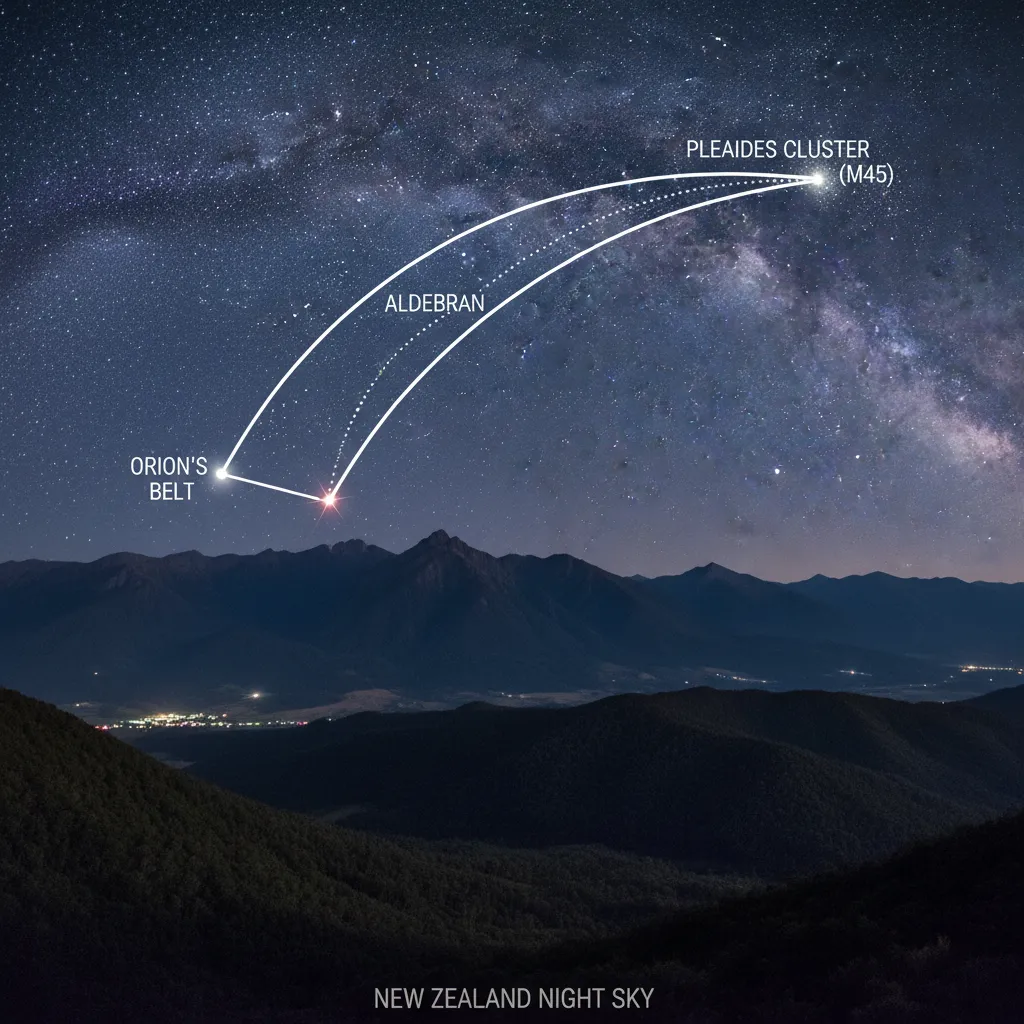
Look for three bright stars aligned in a perfect row. In Western astronomy, this is the belt of Orion the Hunter. In Aotearoa, this is often referred to as the bottom of “The Pot” or Tautoru. These stars are unmistakable and sit relatively high in the eastern sky before dawn.
Step 2: Follow the Line Left
Imagine a straight line running through the three stars of Tautoru. Follow this line to the left (northward). The first bright object you will encounter is a V-shaped pattern of stars. This is the face of Taurus the Bull. The brightest star here is a reddish-orange giant called Taumata-kuku (Aldebaran).
Step 3: Continue to Matariki
Do not stop at the V-shape. Continue your imaginary line from Tautoru, through Taumata-kuku, and keep going for roughly the same distance again. You will land on a tight, fuzzy cluster of stars that looks somewhat like a miniature version of the Little Dipper. This is Matariki. To the naked eye, it appears as a vibration of light or a small cloud of 6 to 9 distinguishable stars, depending on your eyesight and the darkness of the location.
Best Times to View in June and July 2025
Timing is critical when observing Matariki. Because it is a heliacal rising—meaning the stars rise just before the sun—there is a narrow window of opportunity. If you look too early, the cluster may not have risen above the horizon. If you look too late, the light of the rising sun will wash out the stars.
The Pre-Dawn Window
For 2025, the viewing window generally opens between 5:30 AM and 6:30 AM. You want to be in position when the sky is still fully dark, but the cluster has risen high enough to clear any distant hills or trees. The ideal time is usually about 45 minutes before sunrise.
Key Dates for 2025
The Matariki period shifts slightly every year based on the lunar calendar (Maramataka). For 2025, the Matariki public holiday is celebrated on Friday, June 20th. However, the viewing period extends beyond just this day.
- Early June: Matariki reappears in the dawn sky, but it sits very low on the horizon. This requires a completely unobstructed view of the ocean or flat plains to see.
- Late June (June 20-30): This is the prime viewing window. The cluster is higher in the sky, making it easier to spot. The moon phase during this period will dictate visibility; a new moon or crescent moon is preferred over a full moon to reduce light interference.
- Early July: The cluster rises earlier each morning. By mid-July, it is very high in the sky before dawn, offering excellent clarity, though the cultural festivities may have concluded.
Recommended Free Stargazing Apps
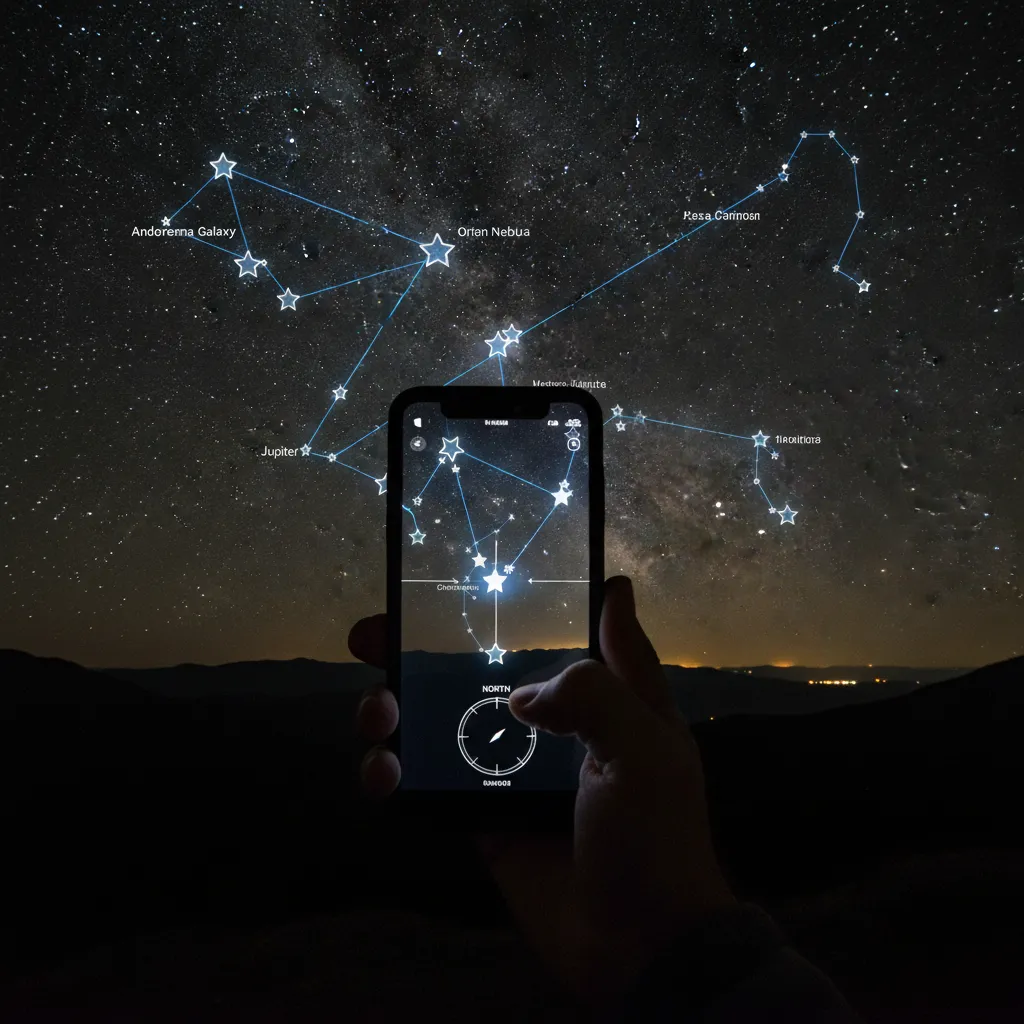
While the goal is to find Matariki without a telescope, modern technology can serve as an excellent training wheel. Using an augmented reality (AR) app on your smartphone can help you confirm you are looking at the correct cluster before you trust your eyes alone.
Stellarium Mobile
Stellarium is widely considered the gold standard for free astronomy software. The mobile version allows you to point your phone at the sky and identifies stars in real-time. It has a “Night Mode” (red screen) to preserve your dark adaptation, which is crucial for spotting the faint glow of the Pleiades.
SkyView Lite
SkyView is incredibly user-friendly. It overlays constellation art onto the camera view, making it easy to spot Orion (Tautoru) and Taurus (Taumata-kuku). Once you identify the path, you can lower the phone and trace the stars with your naked eye.
Star Walk 2
This app offers beautiful visuals and tracks the exact rise and set times of celestial bodies. You can set a notification for when Matariki rises above the horizon in your specific location, ensuring you don’t wake up at 5:00 AM only to find the cluster is still hidden behind a mountain.
Smartphone Photography Tips for Matariki
Capturing the faint light of a star cluster with a smartphone used to be impossible. However, modern sensors and software processing now allow for impressive astrophotography without a DSLR. Here is how to capture Matariki using just your phone.
Stability is Non-Negotiable
Because stars are faint, your camera shutter needs to stay open for several seconds to gather enough light. If you hold the phone in your hand, natural tremors will blur the image into streaks. You must use a tripod. If you do not have one, lean your phone against a rock, a shoe, or a car window to keep it perfectly still.
Using Night Mode
Most modern iPhones and Androids have a dedicated “Night Mode.”
- iPhone: When the environment is dark, the Night Mode icon (a yellow moon) appears. Tap it and slide the timer to “Max” (usually 10-30 seconds if on a tripod).
- Android (Samsung/Pixel): Switch to “Night” or “Night Sight.” If you have a “Pro” mode, set your shutter speed to 15-30 seconds and your ISO to 1600 or 3200.
Focus and Exposure
Autofocus often struggles in the dark. Tap the brightest star on your screen (likely Sirius or Canopus, or Tautoru) to lock focus. Once focused, you may need to manually slide the exposure brightness up slightly. Set a 3-second timer delay so that tapping the shutter button doesn’t shake the phone during the exposure.
The Cultural Significance of the Cluster
Finding the cluster is about more than astronomy; it is about connecting with the environment and history. In Māori tradition, Matariki is the mother surrounded by her daughters. The brightness and distinctness of the stars were traditionally used to predict the productivity of the coming harvest. Clear, bright stars signaled a warm, productive season, while hazy stars warned of cold weather and poor crops.
Viewing Matariki is a communal activity. It is encouraged to go out with whānau (family), share kai (food), and remember those who have passed away since the last rising. When you look up at that tiny cluster without a telescope, you are seeing the exact same sight that navigators used to cross the Pacific Ocean thousands of years ago.

Frequently Asked Questions
What direction do I look to see Matariki?
You must look toward the North-East horizon. The cluster rises in the east and moves higher and northward as the morning progresses.
Can I see Matariki in the city?
Yes, Matariki is visible in cities, but it will be fainter due to light pollution. For the best experience, try to find a local park away from streetlights or drive to a darker rural location.
How many stars should I be able to see?
With the naked eye, most people can distinguish 6 or 7 stars. Those with exceptional eyesight and very dark skies may be able to count up to 9 stars, which correspond to the 9 stars recognized in Māori tradition.
Is Matariki visible all year round?
No. Matariki disappears from the night sky in April and remains hidden behind the sun until it reappears (rises) in mid-winter (June/July). This disappearance and return is what marks the cycle of the New Year.
Do I need binoculars if I don’t have a telescope?
You do not need them, but they can enhance the view. A simple pair of 7×50 or 10×50 binoculars will reveal dozens more stars in the cluster that are invisible to the naked eye, creating a stunning “jewel box” effect.
What if it is cloudy on the morning of Matariki?
If the horizon is cloudy, you will not be able to see the cluster. However, the Matariki viewing period lasts for several weeks. If you miss it on the specific public holiday, simply try again on the next clear morning.