
The Maramataka is the traditional Māori lunar calendar used to mark time based on the movements of the moon and stars. Unlike the solar Gregorian calendar, the Maramataka assigns specific energy levels to daily moon phases, guiding activities like planting, fishing, and resting to align with natural environmental cycles.
For centuries, the Maramataka Māori calendar has served as a sophisticated system of timekeeping, deeply rooted in the observation of the celestial bodies and the natural world. It is not merely a method of counting days but a comprehensive guide to living in harmony with the environment. By understanding the rhythmic pulses of the moon, Māori ancestors optimized their survival and productivity, a practice that is seeing a significant resurgence in modern New Zealand society for its benefits to mental health, productivity, and ecological sustainability.
What is the Maramataka and How Does it Differ from the Gregorian Calendar?
The word Maramataka literally translates to “the moon turning” (marama = moon; taka = to turn or rotate). While the western world operates primarily on the Gregorian calendar—a solar system designed to align the calendar year with the earth’s revolutions around the sun—the Maramataka is a lunar-stellar system. This fundamental difference shifts the focus from an arbitrary grid of dates to a fluid observation of the environment.
In the Gregorian system, a day is simply a unit of time, uniform and indistinguishable from the next in terms of inherent quality. Monday is functionally the same as Tuesday. However, in the Maramataka Māori calendar, every day (or night) has a distinct name and a specific energy profile determined by the phase of the moon. A standard lunar month lasts approximately 29.5 days, resulting in a year that is shorter than the solar year. To reconcile this, the system uses the heliacal rising of stars, such as Matariki (the Pleiades) or Puanga (Rigel), to anchor the lunar cycles to the seasonal year.
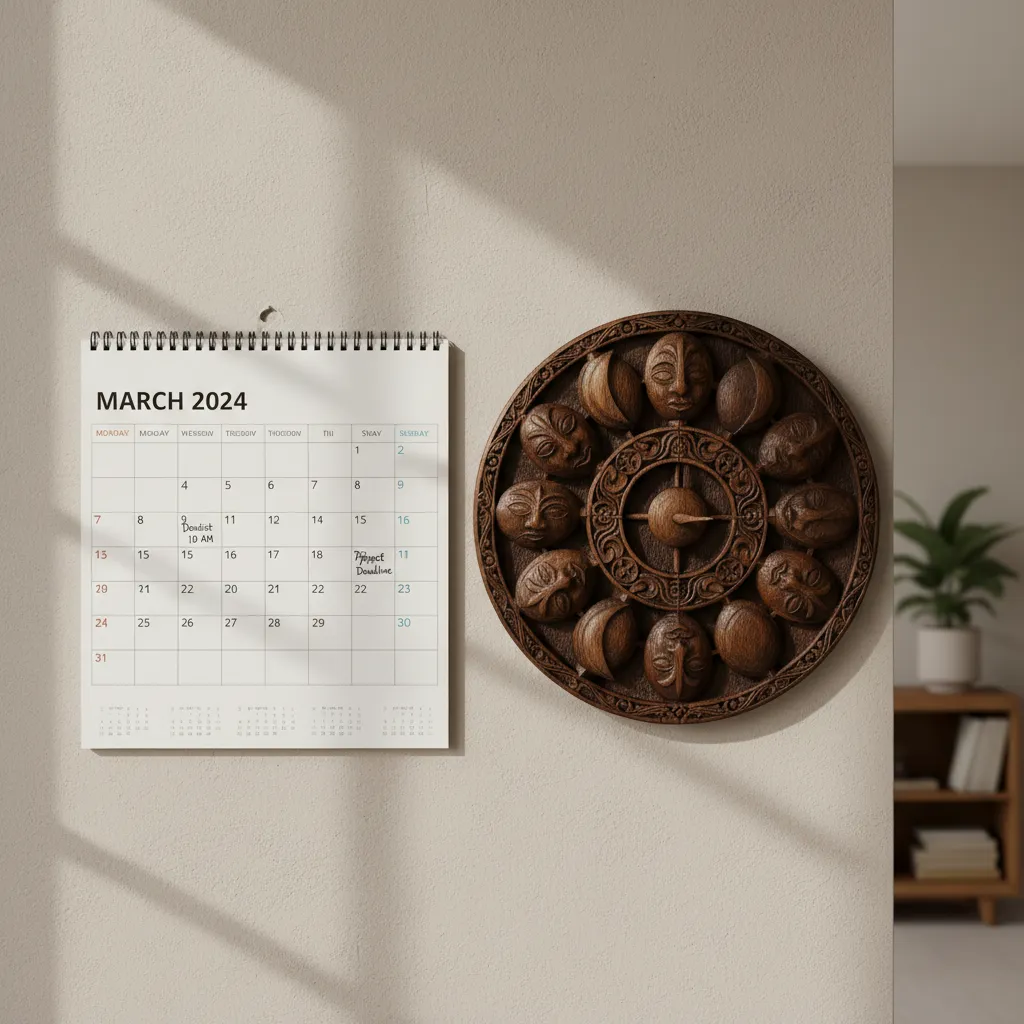
This system is highly localized. While the Gregorian calendar is universal, the Maramataka varies slightly between distinct iwi (tribes) and regions. The environmental cues in the far north of Aotearoa (New Zealand) differ from those in the deep south, meaning the calendar adapts to the specific flora, fauna, and tidal patterns of the local area. It is a system of observation rather than calculation, requiring the user to be present and attentive to the natural world.
The Phases of the Moon and Their Energy Levels
Understanding the Maramataka requires a shift in mindset regarding productivity. The modern work week demands consistent high output from Monday to Friday. Conversely, the Maramataka recognizes that energy—both human and environmental—is cyclical. By aligning tasks with these energy levels, one can achieve better results with less friction.
What are the Low Energy Phases?
The cycle typically begins with Whiro (the New Moon). This is the darkest night of the month. In traditional narratives, Whiro is associated with negative entities or illness, but in a practical sense, it represents the lowest energy point. It is a time for rest, reflection, and planning, rather than doing. It is considered an unfavorable time for planting or fishing.
Following the full moon, as the light wanes, the energy drops again during the Korekore phases. These days are often associated with scarcity or difficulty. It is a time to pause, review work, and handle administrative tasks rather than launching new ventures or seeking food.
What are the High Energy Phases?
As the moon waxes, energy builds. The Tamatea phases occur around the first quarter. These days are known for volatile, unpredictable energy—weather can change rapidly, and ocean currents can be strong. While high energy, it requires caution. It is often described as a time of “high tension,” requiring careful navigation in relationships and physical activities.
The peak productivity days are typically found leading up to and including the Full Moon (Rakaunui). The days of Rapu, Gahuru, and Mawharu are considered highly productive. This is when the sap in trees is running high, and marine life is active. It is the optimal time for community gatherings, high-intensity work, and harvesting.
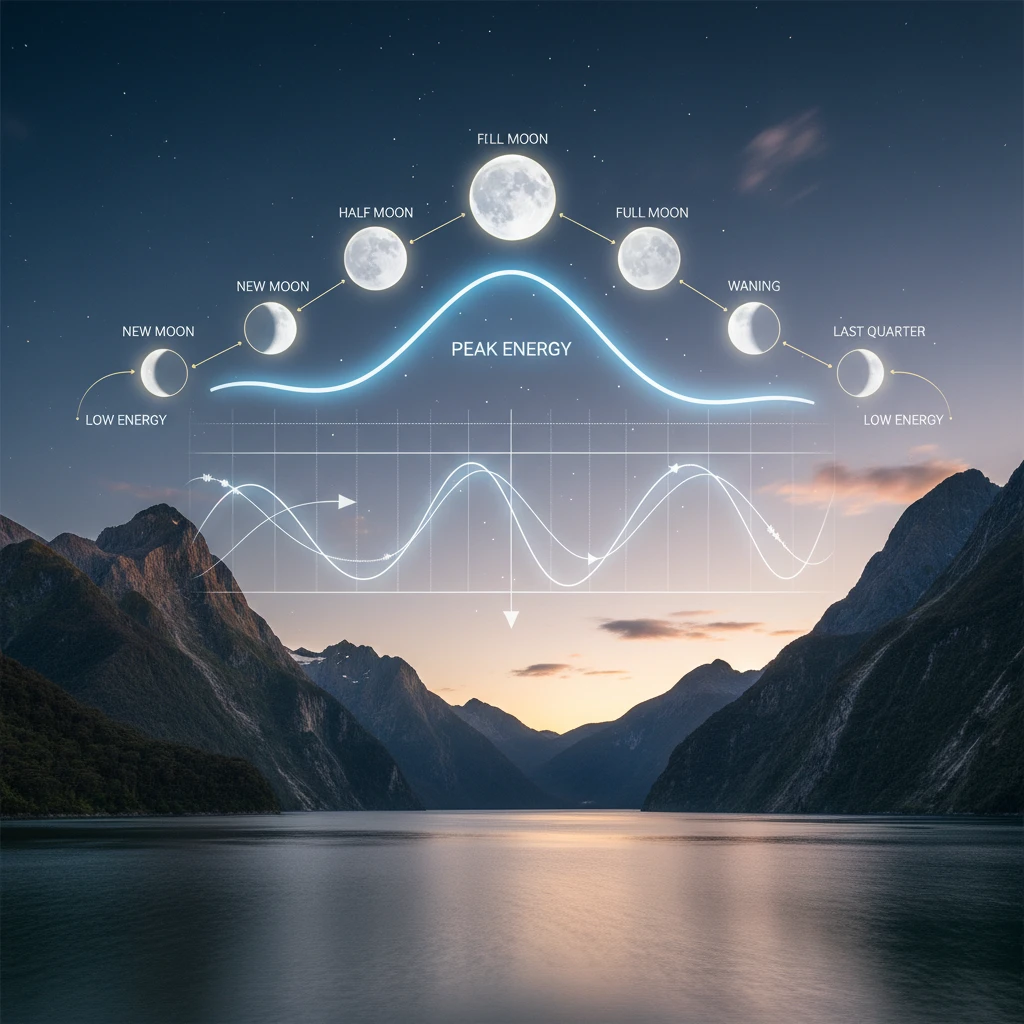
Another significant high-energy period is the Tangaroa phases, which occur a few days after the full moon. Tangaroa is the atua (deity) of the ocean. These days are renowned for fishing and are considered excellent for intellectual pursuits, clarity of thought, and productivity.
How Matariki Resets the Lunar Year
Because the lunar year is approximately 354 days long (11 days shorter than the solar year), the Maramataka requires a reset mechanism to ensure the months stay aligned with the seasons. This reset is marked by the appearance of Matariki (the Pleiades star cluster) or Puanga (Rigel) in the pre-dawn sky in mid-winter (typically June or July).
The rising of Matariki signals the end of the old year and the beginning of the new. It is a time of remembrance for those who have passed during the year (associated with the star Pōhutukawa) and a time to plan for the upcoming planting season (associated with the stars Tupu-ā-nuku and Tupu-ā-rangi).
If the stars appeared bright and clear, it foretold a warm, productive season. If they were hazy, it signaled a cold winter and potentially poor crops. This celestial reset allowed Māori tohunga (experts) to insert an intercalary month when necessary to realign the lunar calendar with the solar year, ensuring that the month of planting actually coincided with spring warmth.
Using the Maramataka for Fishing and Planting
The Maramataka is arguably most valuable as a survival guide. Its predictive nature regarding animal behavior and plant biology allowed ancestors to maximize their yield with efficient effort. Today, gardeners and anglers utilize these same principles.
How to Use Maramataka for Fishing
Fishing by the Maramataka is not superstition; it is based on the gravitational pull of the moon affecting tides and the light levels affecting fish behavior.
- Tangaroa Phases: These are the premier fishing days. The currents are favorable, and fish are actively feeding. It is often said that during Tangaroa, “the fish hook themselves.”
- Rakaunui (Full Moon): While the moon is bright, fishing can be hit or miss depending on the species. Eels (tuna) are often shy of the bright light and hide, making it a poor time for eeling. However, it can be excellent for deep-sea fishing where light penetration helps visibility.
- Korekore Phases: As the name implies (kore means zero or nothing), these are poor fishing days. The tides may be sluggish, and fish are less active. Experienced lawaiʻa (fishermen) use this time to repair nets and maintain gear rather than wasting energy on the water.
How to Use Maramataka for Planting
Gardening by the moon aligns agricultural activities with the water table and sap flow within plants.
- Mawharu: Occurring just before the full moon, this is widely considered the best day for planting. The gravitational pull draws moisture up to the surface of the soil, assisting germination. It is ideal for planting large, above-ground crops like kumara.
- Whiro (New Moon): While generally low energy, the darkness and the subsequent waxing phase make it a decent time for planting root vegetables, as the energy begins to direct downward before building up again.
- Korekore: These days are avoided for planting. Seeds sown now are believed to result in weak plants with low yield. Instead, this time is used for weeding and soil preparation.

The Revitalization of Maramataka Knowledge in NZ
For many years following colonization, the use of the Maramataka diminished as the Gregorian calendar became the standard for commerce and government. However, Aotearoa is currently experiencing a profound renaissance of this knowledge. This revitalization is driven by a desire to reconnect with indigenous wisdom and a recognition of the limitations of the modern, linear time structure.
Leading experts like Professor Rangi Matamua have been instrumental in making this knowledge accessible. His work in decoding the 400+ names of stars and their connection to the Maramataka has brought the system back into the mainstream consciousness. This resurgence culminated in the official recognition of Matariki as a public holiday in New Zealand, the first indigenous holiday of its kind.
Beyond cultural pride, the Maramataka is being applied in modern contexts:
- Health and Wellbeing: Mental health organizations are using the Maramataka to help people track their moods. Recognizing that it is natural to feel low energy during Whiro helps de-stigmatize depressive feelings and encourages rest.
- Business and Planning: Some Māori organizations now schedule strategic planning days during high-energy phases like Tangaroa and avoid scheduling major hui (meetings) during Korekore days.
- Environmental Management: Conservation groups are looking to the Maramataka for cues on when to monitor species and when to allow ecosystems to rest.
Living by the Maramataka offers a framework for a balanced life. It encourages us to observe the world around us, to rest without guilt when energy is low, and to act with conviction when the conditions are right. In a world of burnout and disconnection, the Maramataka Māori calendar offers a timeless solution: rhythm over speed.
Frequently Asked Questions
What is the best day for fishing in the Māori calendar?
The best days for fishing are generally during the Tangaroa phases (Tangaroa-ā-mua, Tangaroa-ā-roto, Tangaroa-kiokio). These days typically occur 3-6 days after the full moon. The ocean currents are favorable, and fish activity is at its peak, leading to more successful catches.
How many days are in a Maramataka month?
A lunar month in the Maramataka is typically 29.5 days long. Because a calendar cannot have half-days, the months alternate between 29 and 30 days. This results in a lunar year of approximately 354 days, requiring an environmental reset (Matariki) to align with the solar year.
What does the Whiro moon phase mean?
Whiro is the New Moon phase, representing the start of the lunar cycle. It is the darkest night of the month and is considered a time of low energy. It is traditionally a time for rest, planning, and reflection rather than starting new physical activities or planting crops.
Can I use the Maramataka for modern business planning?
Yes, many organizations are adopting the Maramataka for business. High-energy phases like Rakaunui and Tangaroa are used for executing projects, strategic planning, and team building. Low-energy phases like Korekore are utilized for administrative tasks, reviewing accounts, and individual rest.
Is the Maramataka the same for all Māori tribes?
No, the Maramataka is highly localized. While the core phases are similar, specific names and environmental indicators vary between iwi (tribes). Coastal tribes will have a calendar focused on ocean tides and marine life, while inland tribes focus more on forest and river cycles.
What is the relationship between Matariki and the Maramataka?
Matariki (the Pleiades star cluster) acts as the anchor for the Maramataka. The heliacal rising of Matariki in mid-winter signals the start of the Māori New Year. This celestial event resets the lunar calendar, ensuring that the lunar months stay aligned with the seasonal solar year.