Rigel, also known as Beta Orionis or Puanga in Māori astronomy, is a massive blue supergiant star located approximately 860 light-years from Earth. It is the seventh-brightest star in the night sky, radiating with a luminosity roughly 120,000 times that of the Sun, and serves as a critical celestial marker for the New Year in specific regions of New Zealand.
While the night sky is filled with billions of celestial bodies, few command attention quite like Rigel. Dominating the constellation of Orion, this stellar behemoth offers more than just a sparkling point of light; it provides a laboratory for understanding the extremes of stellar physics. For observers in New Zealand, Rigel holds a dual identity: it is an astrophysical marvel of extreme temperature and mass, and it is Puanga, a culturally vital signifier of seasonal change and harvest. This guide explores the comprehensive Rigel star facts, bridging the gap between high-energy astrophysics and the cultural heritage of Aotearoa.
What is the Classification of Rigel?
To understand Rigel, one must first understand its classification within the Hertzsprung-Russell diagram, the fundamental roadmap of stellar evolution. Rigel is officially classified as a Blue Supergiant, specifically of the spectral type B8 Ia. This designation is packed with physical information regarding the star’s temperature, size, and evolutionary stage.
Breaking Down the Spectral Type B8 Ia
The classification code “B8 Ia” tells astronomers specific details about the star’s physical state:
- B: This denotes the spectral class. Class B stars are very hot and blue-white in color. They are defined by the presence of neutral helium lines in their spectra, which require immense temperatures to appear.
- 8: This subdivision (0-9) indicates that Rigel is on the cooler end of the B class, transitioning toward class A. However, “cooler” is relative; it is still scorching compared to our Sun.
- Ia: This is the luminosity class. “I” stands for supergiant, and the suffix “a” indicates it is a luminous supergiant, as opposed to “Ib,” which would be a less luminous supergiant.
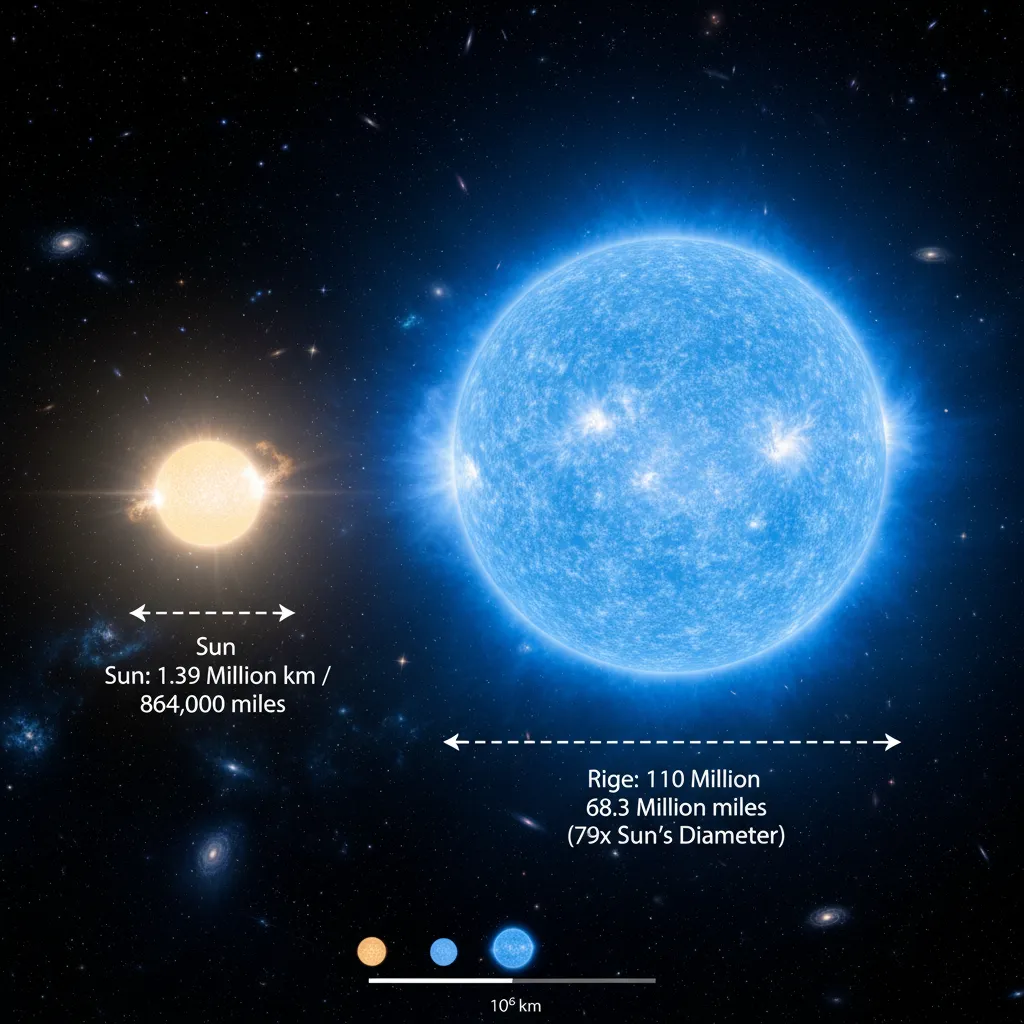
Unlike our Sun, which is a G-type Main Sequence star (burning hydrogen into helium steadily), Rigel has evolved off the main sequence. It has exhausted the hydrogen in its core and is now burning heavier elements. This evolutionary step causes the star to swell to immense proportions. Rigel’s radius is estimated to be over 70 times that of the Sun. If placed in our solar system, it would extend nearly to the orbit of Mercury.
The Cultural Significance: Puanga in New Zealand
While modern astrophysics categorizes Rigel by its fusion processes, the indigenous people of New Zealand, the Māori, have known this star for centuries as Puanga. Understanding the Rigel star facts requires acknowledging this deep cultural connection, which is vital for regional tourism and education in New Zealand.
Puanga vs. Matariki
Most people are familiar with Matariki (the Pleiades star cluster) as the signifier of the Māori New Year. However, the geography of New Zealand influences what stars are visible. In parts of the country, such as the West Coast of the South Island, Northland, and Taranaki, the mountain ranges or local horizons can obscure the view of Matariki during its heliacal rising in mid-winter. For those interested in the astronomical differences, check out our Puanga vs. Matariki: Regional Variations guide.
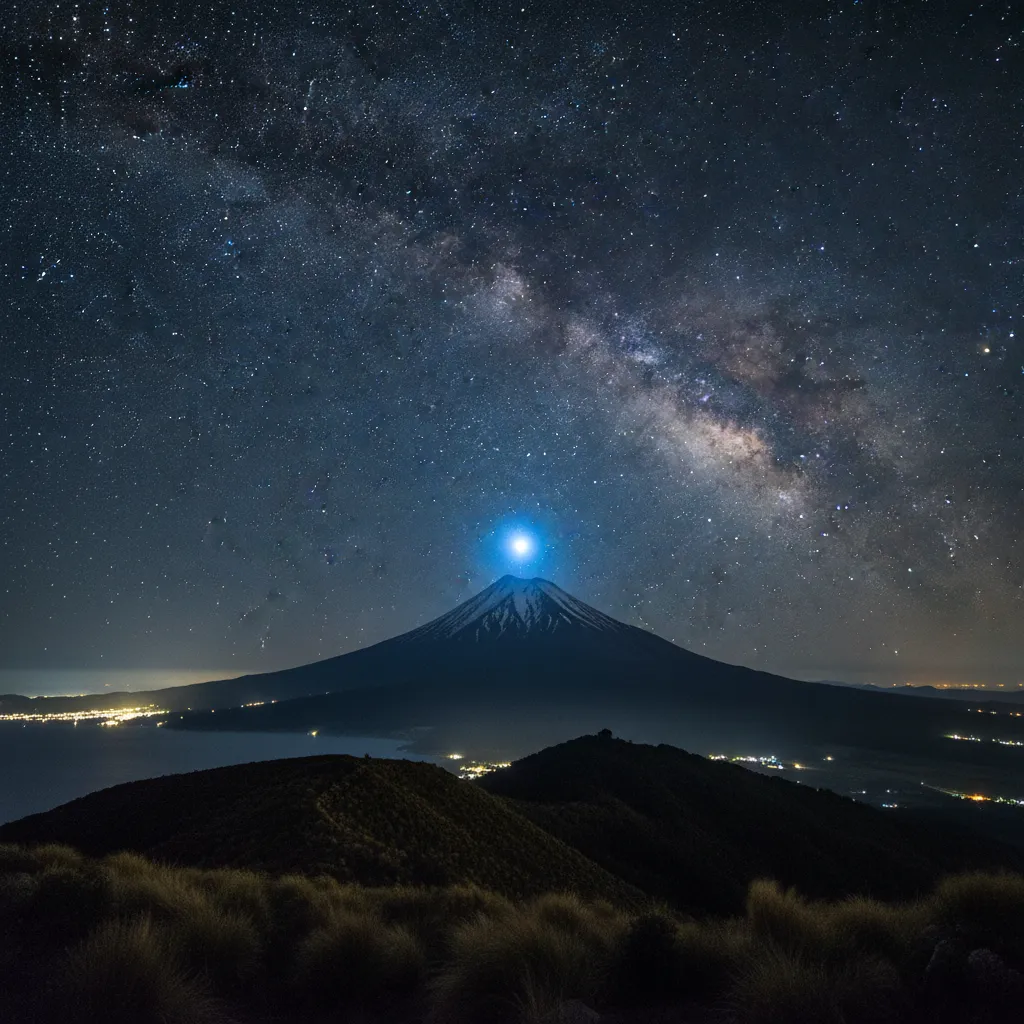
For iwi (tribes) in these regions, the rising of Puanga (Rigel) is the primary marker for the New Year. Puanga rises higher and brighter in the eastern sky and is often easier to spot than the cluster of Matariki. The phrase “Puanga kai rau” (Puanga of the plentiful food) refers to the star’s role in signaling the time to store crops and prepare for the winter months. In the context of New Zealand tourism, visitors often seek out Dark Sky Sanctuaries specifically to witness the rise of Puanga, connecting the physical grandeur of the star with its role as a calendar keeper. Planning a gathering? We have tips on Catering for Matariki Events.
Brightness and Luminosity: How Bright is Rigel?
Rigel is an energetic powerhouse. When discussing Rigel star facts, its luminosity is perhaps its most terrifyingly impressive attribute. It is the seventh-brightest star in Earth’s night sky, but this visual ranking belies its true power due to its distance.
Absolute vs. Apparent Magnitude
Astronomers distinguish between how bright a star looks from Earth (apparent magnitude) and how bright it actually is (absolute magnitude).
- Apparent Magnitude: Rigel has an apparent magnitude of roughly 0.12. This makes it a “zero-magnitude” star, serving as a standard calibration point for amateur astronomers. It is actually a variable star, meaning its brightness fluctuates slightly due to pulsations in its atmosphere, ranging from 0.05 to 0.18.
- Absolute Magnitude: If we were to line up all stars at a standard distance of 10 parsecs (32.6 light-years), the Sun would be a dim speck. Rigel, however, boasts an absolute magnitude of -7.84.
Energy Output
Rigel pours out energy at a rate that is difficult to comprehend. Its luminosity is approximately 120,000 times that of the Sun. This immense energy output is driven by the rapid consumption of nuclear fuel in its core. Because it burns so hot and so fast, Rigel emits a significant portion of its energy in the ultraviolet (UV) spectrum, which is invisible to the human eye. If our eyes could see UV light, Rigel would appear even more dominant in the Orion constellation.
Distance and Location: Where is Rigel?
Rigel acts as the left foot of Orion the Hunter (or the top right corner of “The Pot” as seen from the Southern Hemisphere in New Zealand). Despite appearing as a neighbor to Betelgeuse (Orion’s shoulder), the two stars are vastly distant from one another in three-dimensional space.
Distance from Earth
Rigel is located approximately 860 light-years (about 260 parsecs) from our solar system. The light hitting your retinas tonight when you look at Rigel left the star nearly a millennium ago, around the time the Polynesian voyagers were navigating the Pacific Ocean toward Aotearoa.
The Witch Head Nebula
One of the most spectacular proofs of Rigel’s intensity is its interaction with the surrounding interstellar medium. Rigel is not located in a vacuum; it is associated with the Orion OB1 Association. The star is so luminous that it lights up a reflection nebula known as the IC 2118, or the Witch Head Nebula. Located about 40 light-years away from the star itself, the dust in this nebula reflects Rigel’s blue light, creating a ghostly, azure silhouette that is a favorite target for astrophotographers in New Zealand’s dark sky reserves.
The Physics of Color: Why is Rigel Blue?
To the naked eye, Rigel appears as a piercing blue-white point of light. This color is a direct result of surface temperature physics, governed by Wien’s Displacement Law.
Temperature and Wavelength
Stars behave roughly like “black body” radiators. As an object gets hotter, the peak wavelength of the light it emits shifts toward the blue and ultraviolet end of the spectrum.
Our Sun, with a surface temperature of about 5,500 degrees Kelvin, peaks in the yellow-green part of the spectrum (appearing white/yellow to us). Rigel, however, has a surface temperature of approximately 12,100 Kelvin (roughly 21,300 degrees Fahrenheit). At this blistering temperature, the photons emitted are highly energetic, resulting in the distinct blue hue.
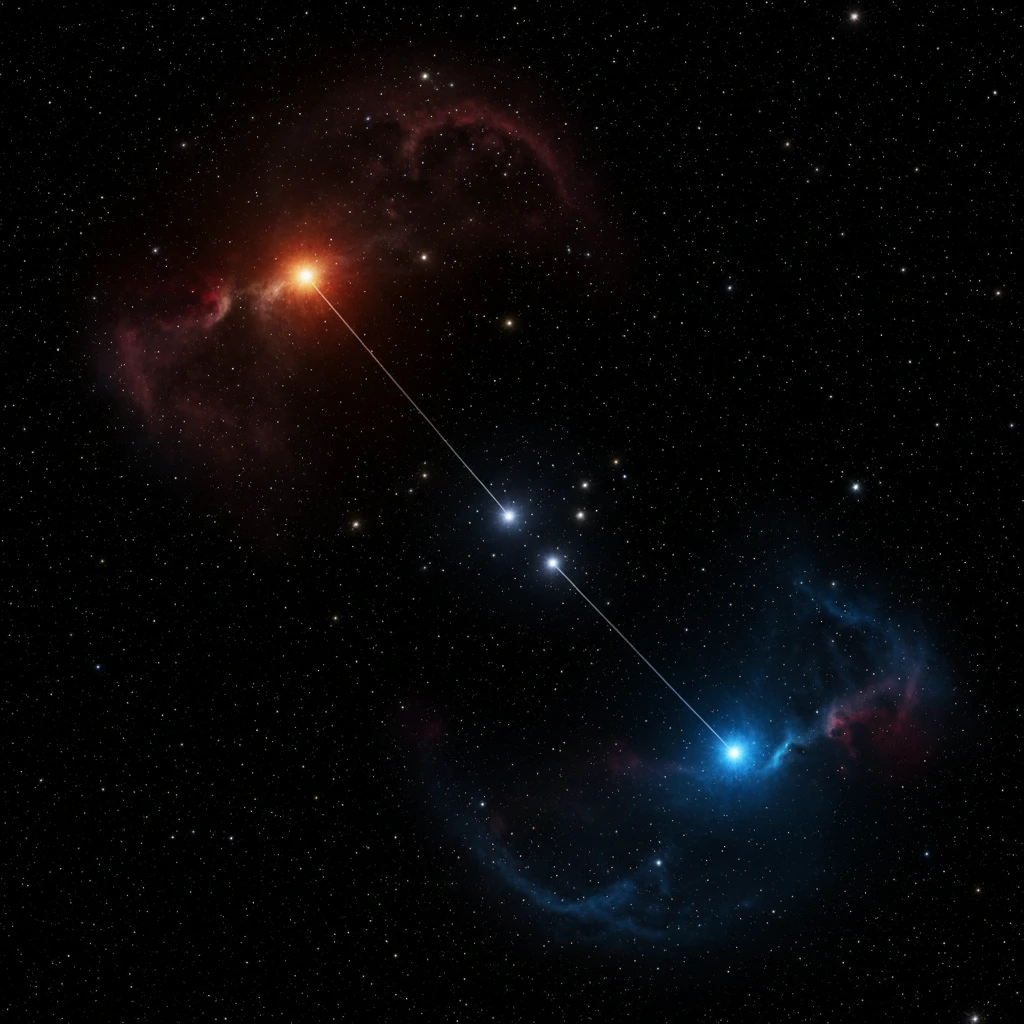
This contrasts sharply with Betelgeuse, the other supergiant in Orion. Betelgeuse is a Red Supergiant with a surface temperature of roughly 3,500 Kelvin. The visual contrast between Rigel (Blue/Hot) and Betelgeuse (Red/Cool) provides one of the best naked-eye examples of stellar thermodynamics available to stargazers.
The Lifecycle of a Blue Supergiant
The life of a Blue Supergiant like Rigel is a story of “live fast, die young.” While stars like our Sun can burn for 10 billion years, massive stars have much shorter lifespans due to the immense gravitational pressure compressing their cores.
Current Evolutionary Stage
Rigel is estimated to be roughly 8 million years old. While this sounds ancient in human terms, it is an infant compared to the Sun (4.6 billion years). However, Rigel is already nearing the end of its life. It has exhausted the hydrogen in its core and is likely fusing helium into carbon and oxygen. This phase involves significant mass loss; Rigel ejects material through a violent stellar wind that is 10 million times stronger than the Solar wind.
The Future Supernova
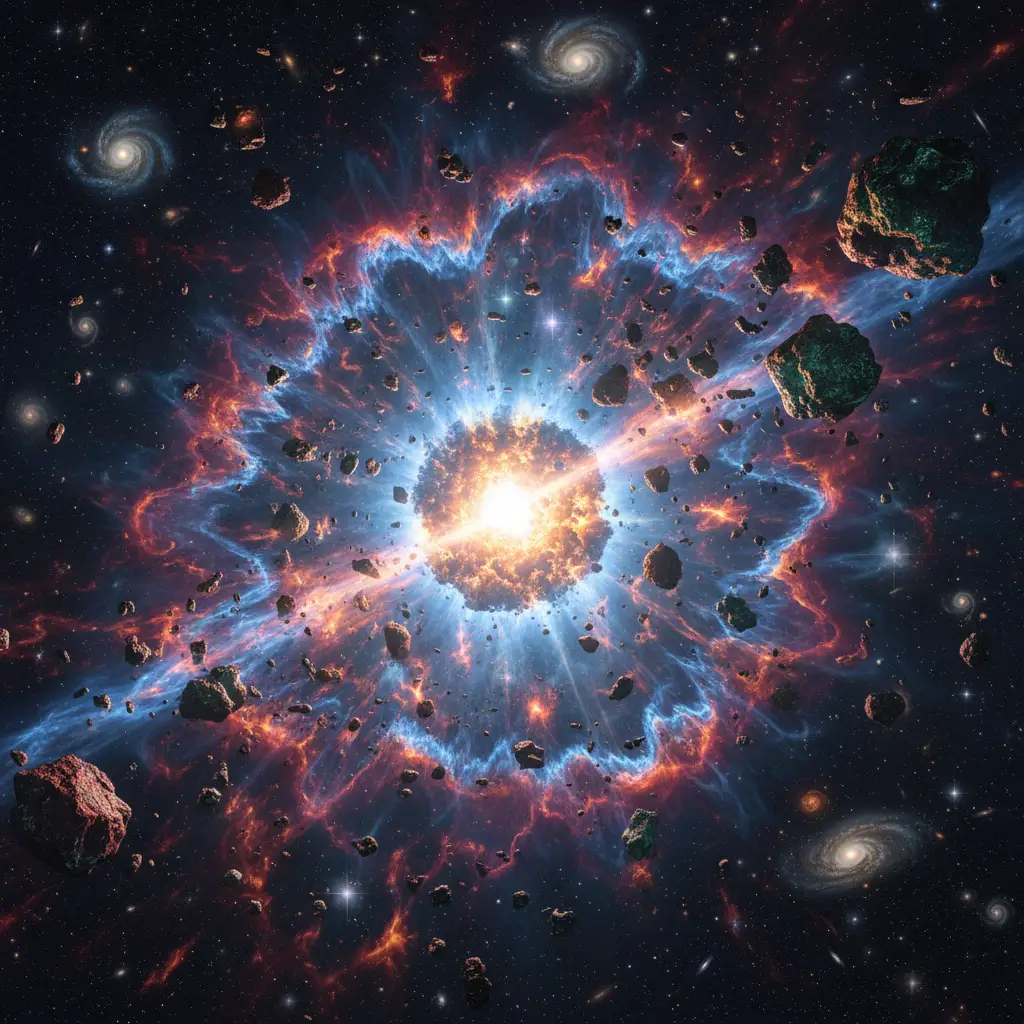
What is the ultimate fate of Rigel? Because it has a mass estimated at 21 times that of the Sun, it is destined to end its life in a cataclysmic explosion known as a Type II Supernova.
When the core eventually fuses elements all the way up to iron, fusion will cease. Without the outward pressure of fusion to counteract gravity, the core will collapse in a fraction of a second, followed by a massive rebound explosion. When this happens, Rigel could shine as brightly as the half-moon, visible even during the day. Following the explosion, the remnant core will likely collapse into a neutron star or potentially a black hole, depending on how much mass is lost prior to detonation.
Viewing Rigel from New Zealand
For tourists and locals in New Zealand, viewing Rigel (Puanga) is best done during the winter months (June to August), though Orion is visible in the late evening sky during summer as well. In the Southern Hemisphere, Orion appears “upside down” compared to the Northern view. For tips on accurately locating the star, consult our Interactive Night Sky Map Tool: Locate Matariki Now.
Finding “The Pot”
To find Rigel, look for the three stars of Orion’s Belt. In New Zealand, this is often called the bottom of “The Pot.” Rigel is the bright blue star positioned above and to the left of the belt (forming the handle/corner of the pot).
Best Locations for Viewing
To truly appreciate the blue magnitude of Rigel and the faint nebulosity surrounding the constellation, one should visit a Dark Sky Sanctuary. New Zealand offers some of the best in the world:
- Aoraki Mackenzie International Dark Sky Reserve: Located in the South Island, this is the gold standard for stargazing. The lack of light pollution allows Rigel’s color to pop against the velvet black background.
- Aotea / Great Barrier Island: An island sanctuary off the coast of Auckland, perfect for viewing Puanga rising over the ocean.
- Rakiura / Stewart Island: The southernmost Dark Sky Sanctuary, offering long winter nights perfect for extended observation.
Understanding the physics of Rigel enhances the experience of viewing it. When you look up at that blue point of light from the shores of New Zealand, you are witnessing a nuclear reactor 120,000 times brighter than the Sun, a cultural beacon for the Māori people, and a future supernova waiting to happen.
Frequently Asked Questions
Is Rigel bigger than the Sun?
Yes, significantly. Rigel is a Blue Supergiant with a radius approximately 70 to 79 times that of the Sun. In terms of mass, it contains about 21 times the mass of the Sun. If Rigel were placed at the center of our solar system, it would extend nearly to the orbit of Mercury.
What does Puanga mean in Māori astronomy?
In Māori astronomy, Rigel is known as Puanga. For many tribes (iwi), particularly in the West Coast and Northland regions of New Zealand, the heliacal rising of Puanga signals the start of the Māori New Year, serving a similar role to Matariki (the Pleiades) in other regions.
Will Rigel explode into a supernova?
Yes. Due to its high mass (approx. 21 solar masses), Rigel is destined to end its life as a Type II supernova. This will likely occur within the next few million years. When it explodes, it will be visible from Earth during the day.
How far is Rigel from Earth?
Rigel is located approximately 860 light-years (263 parsecs) away from Earth. Despite this vast distance, it appears incredibly bright in our sky because of its immense intrinsic luminosity.
Why does Rigel appear blue?
Rigel appears blue because of its extreme surface temperature. With a temperature of over 12,000 Kelvin, Rigel emits most of its light in the blue and ultraviolet distinct wavelengths. Cooler stars appear red or yellow, while the hottest stars appear blue.
Is Rigel part of the Matariki cluster?
No. Rigel (Puanga) is a single star in the constellation Orion, while Matariki is an open star cluster (the Pleiades) located in the constellation Taurus. However, both are used in New Zealand as markers for the New Year depending on the region.