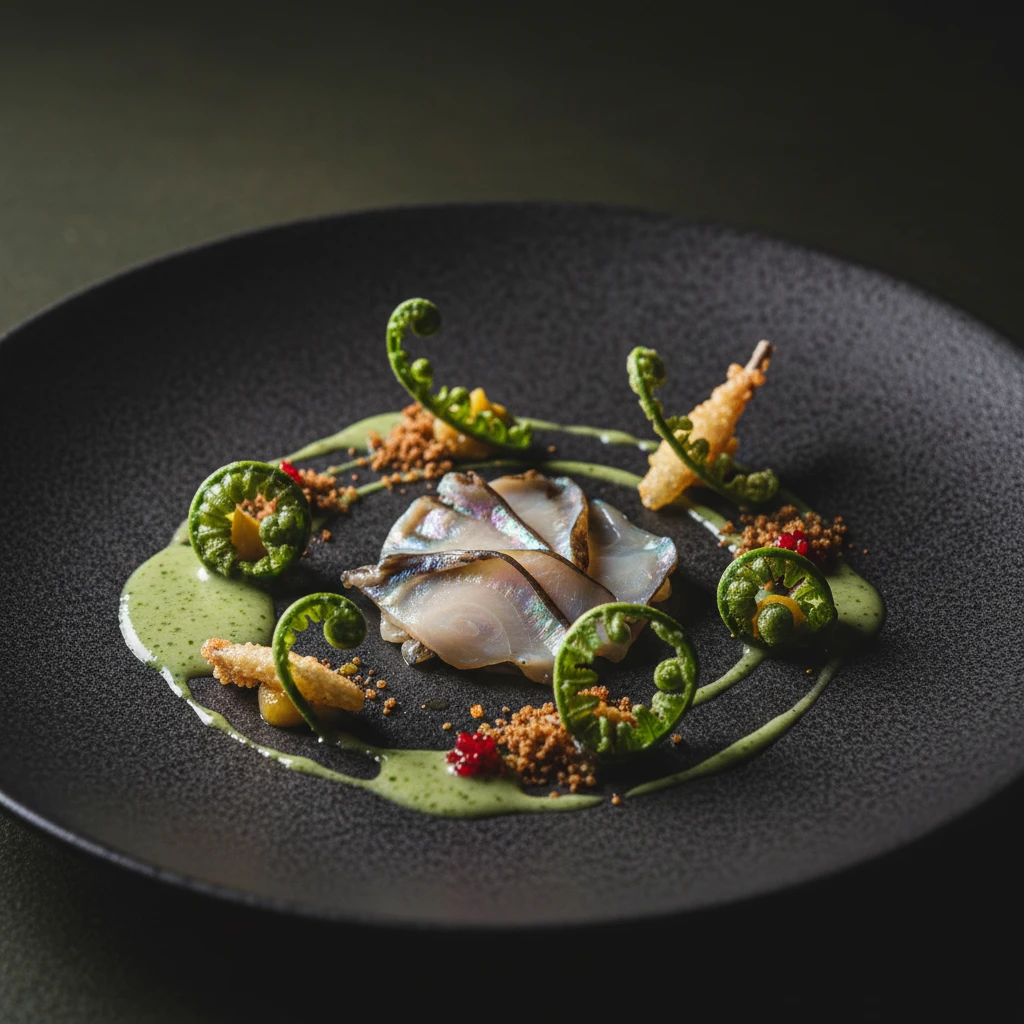
Traditional Maori games for Matariki, known as Tākaro, are ancestral pastimes played to sharpen mental agility, physical coordination, and social connection during the Māori New Year. Essential games include Mū Tōrere (strategic board game), Tī Rākau (rhythmic stick games), and Whai (string figures), all designed to preserve whakapapa and enhance cognitive skills.
As the star cluster Matariki rises, signaling the Māori New Year, communities across Aotearoa New Zealand gather to reflect, celebrate, and plan for the future. A vital component of these celebrations is the revitalization of Tākaro (traditional games). These activities are not merely sources of entertainment; they are deep pedagogical tools used to transfer knowledge, history, and physical prowess from one generation to the next. In the context of Matariki, playing these games serves as a method to sharpen the mind and body during the colder winter months.
What is the Significance of Tākaro During Matariki?
Tākaro encompasses a wide array of traditional Māori games and sports. Historically, these were vital for training warriors, teaching genealogy (whakapapa), and fostering social cohesion within the hapū (sub-tribe). During Matariki, which occurs in mid-winter, outdoor activities were often limited by weather, making indoor games and close-quarter physical challenges essential for maintaining fitness and morale.
Integrating traditional Maori games for Matariki into modern celebrations allows participants to reconnect with ancestral knowledge. It is a time when the harvest has been stored, and the focus shifts to learning and whanaungatanga (relationship building). Whether in schools, community centers, or corporate team-building events, Tākaro offers a unique window into the Māori worldview (Te Ao Māori).
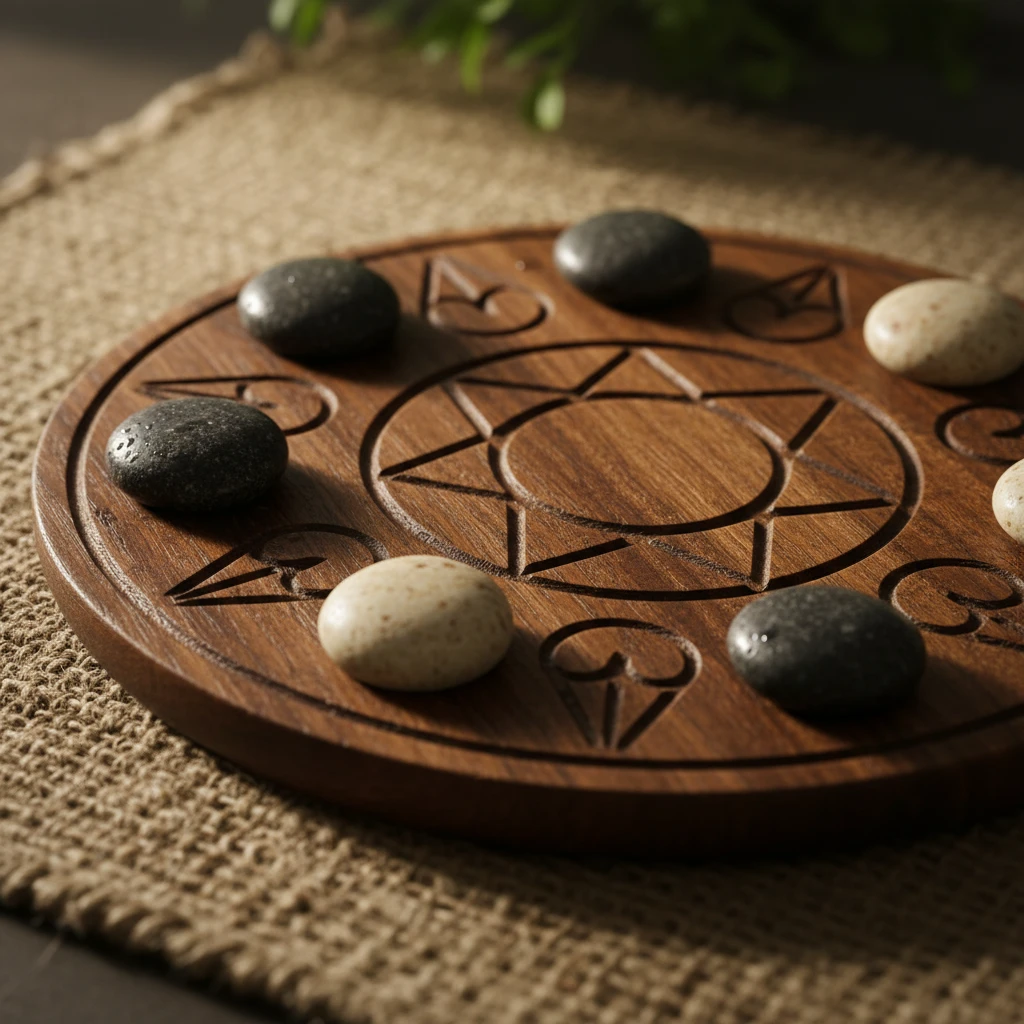
How to Play Mū Tōrere (Board Game)
Mū Tōrere is one of the only board games indigenous to the Māori people, originating specifically from the Ngāti Porou tribe on the East Coast of the North Island. It is a two-player strategy game that is deceptively simple to learn but difficult to master, often compared to draughts or chess in its requirement for forward-thinking.
The Board and Setup
The board, known as the papa tākaro, consists of an eight-pointed star design. The center point is called the pūtahi, and the eight points of the star are the kewai.
- Players: 2
- Pieces: Each player needs 4 pieces (perepere). Traditionally, these are contrasting stones or shells (e.g., 4 light stones and 4 dark stones).
- Starting Position: The pieces are placed on the kewai (outer points). The pūtahi (center) is left empty. Players arrange their pieces on adjacent points, occupying half the circle each.
Rules of Engagement
The objective is to block your opponent so they cannot make a valid move. The game ends when a player is stalemated.
- Opening Move: The first player moves one of their pieces into the empty center (pūtahi). However, a critical rule applies: You cannot move to the center from a position where the two adjacent outer points are occupied by your own pieces. You must have at least one enemy piece adjacent to your moving piece to enter the center.
- Subsequent Moves: Players take turns moving one piece at a time. A piece can move from an outer point (kewai) to the center (pūtahi), or from the center to an empty outer point.
- Movement Restrictions: Pieces can move to adjacent outer points if the design allows (some boards have a circle connecting the points), but typically, movement is strictly between the outer points and the center.
- Winning: You win when your opponent’s pieces are blocked and they cannot make a legal move.
Strategic Tips for Mū Tōrere
Success in Mū Tōrere requires anticipating your opponent’s moves several steps ahead. Avoiding the “tapu” (illegal) opening move is just the beginning. Skilled players try to dominate the center position, forcing their opponent into a corner where their pieces become clustered and immobile. It is an excellent game for developing mathematical thinking and spatial awareness.
Hand Games (Whai) and String Figures
Whai (string games) are far more than simple childhood pastimes. In traditional Māori society, they were used to tell stories, record history, and improve manual dexterity. The intricate patterns created with a loop of flax string (harakeke) often represent mythological figures, stars, or elements of nature.
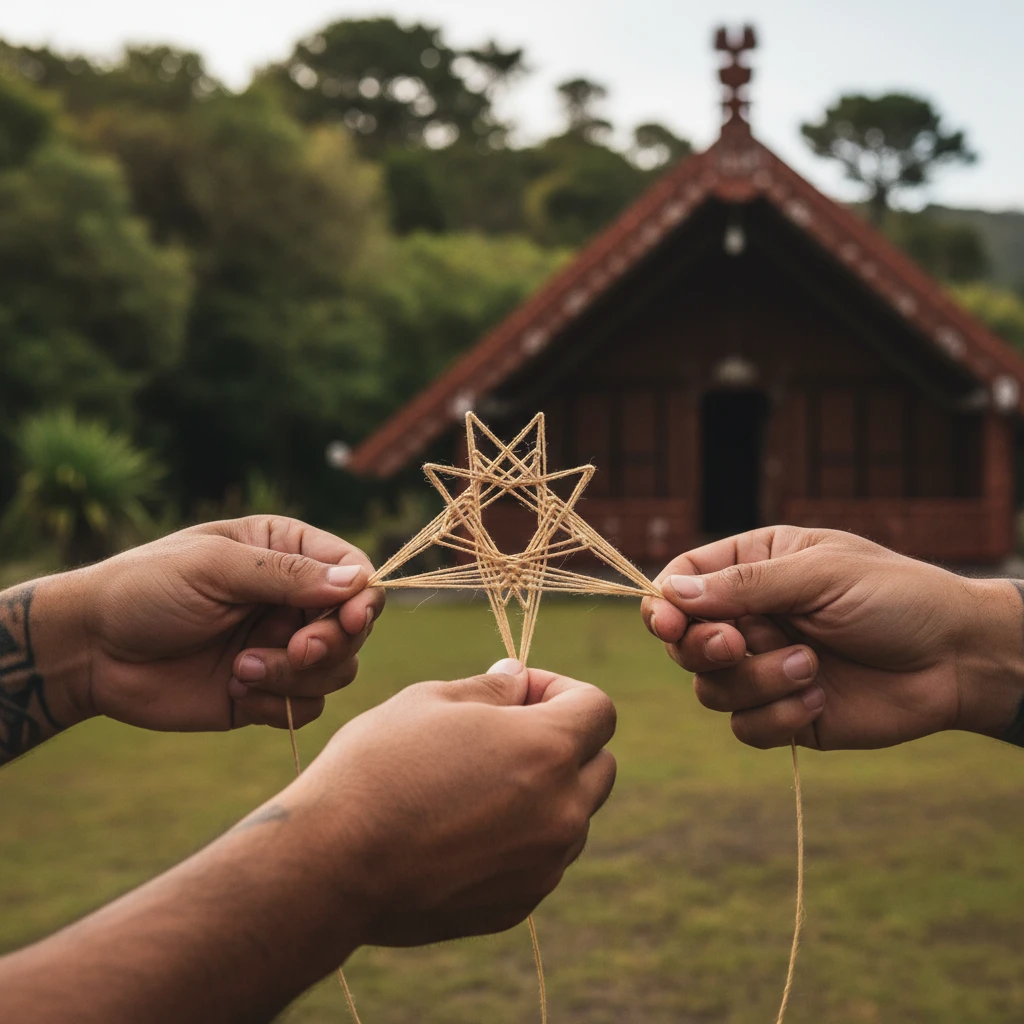
Cultural Significance of Whai
Legend states that the knowledge of string figures comes from the atua (gods) and was taught by the hero Māui. Consequently, playing Whai is sometimes referred to as te whai a Māui (the string games of Māui). During Matariki, these games are particularly appropriate as they encourage storytelling and the transmission of oral traditions.
Common Patterns to Learn
For beginners looking to introduce Whai into a Matariki curriculum, start with these fundamental figures:
- Te Kapu (The Cup): A basic figure often the starting point for more complex designs.
- Te Tāmanuhiri (The Visitor): A dynamic figure that can ‘move’ when the strings are pulled.
- Ngā Taimana (The Diamonds): A series of diamond shapes representing stars, highly relevant for Matariki.
Developmental Benefits
Practicing Whai enhances fine motor skills, hand-eye coordination, and memory. For children, the sequence of movements required to create a figure acts as a physical algorithm, teaching procedural thinking. It requires patience and persistence, virtues celebrated during the New Year period.
Stick Games (Tī Rākau) for Coordination
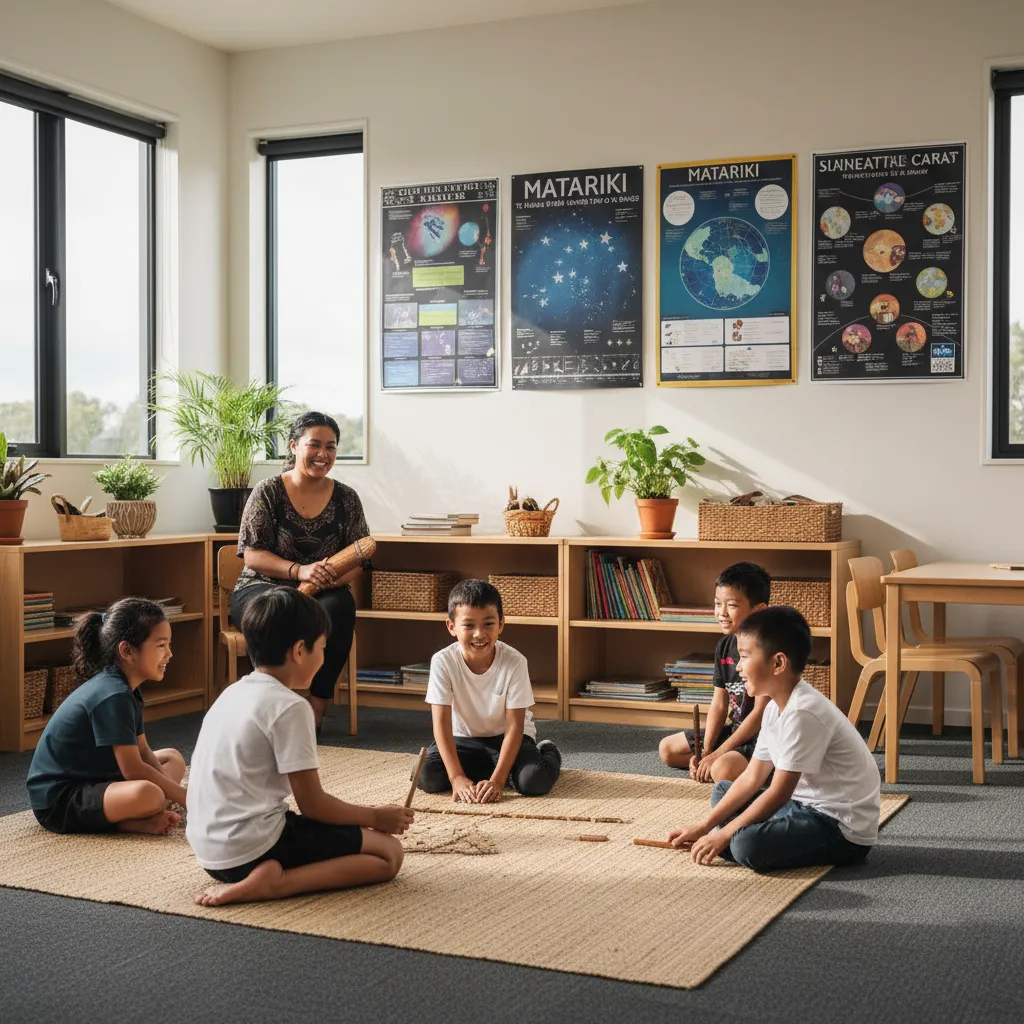
Tī Rākau (also known as Tītī Tōrea) involves the rhythmic tossing and catching of wooden sticks to the beat of a chant or waiata. Historically, this was a martial training exercise designed to improve the hand-eye coordination and reaction speeds of warriors. Today, it is a beloved performance art and educational game.
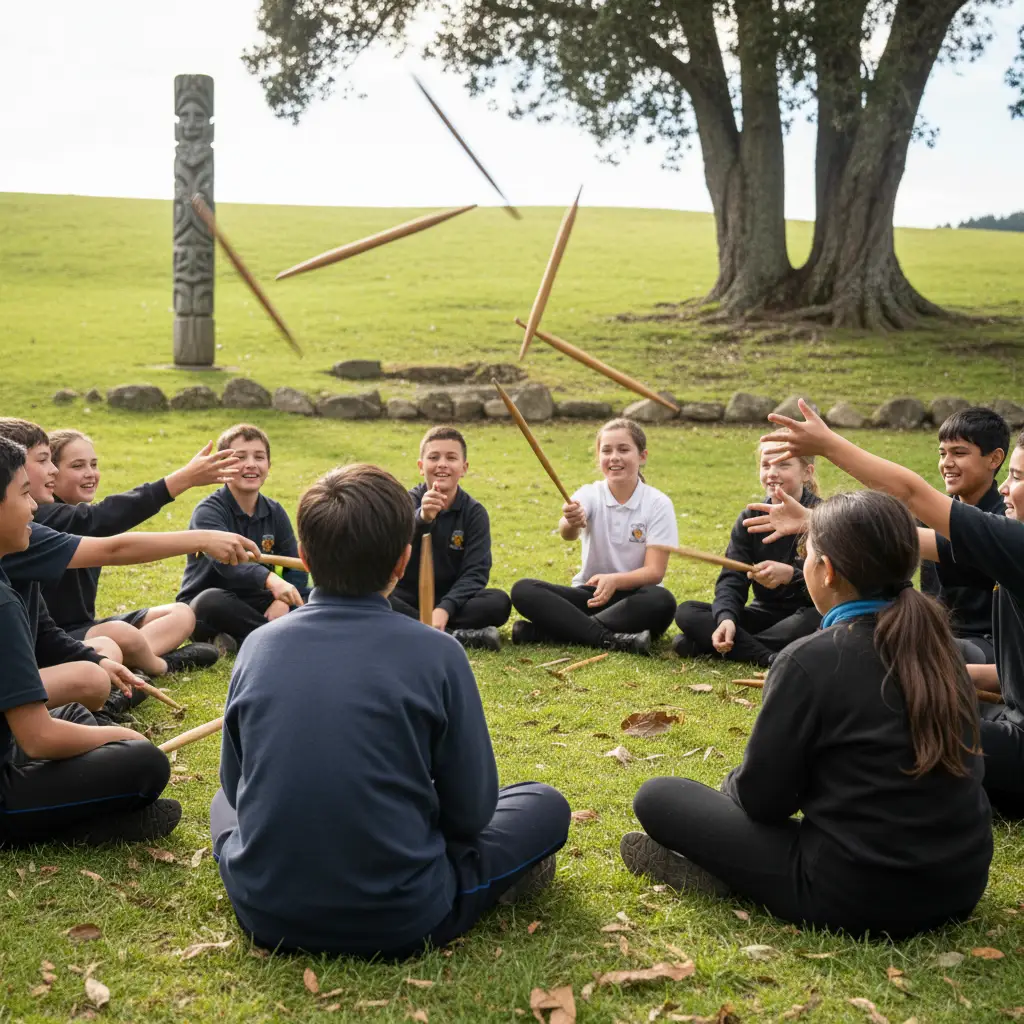
How to Play Tī Rākau
Tī Rākau is typically played in a seated circle or in pairs. Players kneel on the ground, facing each other.
- Equipment: Two wooden sticks (rākau) per player. Traditionally made from light, durable wood, modern versions often use rolled newspaper or dowel rods for safety.
- Rhythm: The game is driven by a steady beat. A popular song for beginners is “E Pāpā Waiari.”
- Basic Movements:
- Tap: Tap the ends of the sticks on the floor.
- Clap: Hit the sticks together.
- Throw: Toss the right stick to the partner’s left hand, while receiving their right stick in your left hand.
- Flip: Toss the stick in the air and catch it.
The Importance of Kotahitanga (Unity)
Tī Rākau cannot be played successfully without cooperation. If one person loses the rhythm, the sticks drop, and the flow is broken. This makes it a powerful metaphor for community and unity (kotahitanga) during Matariki. It teaches participants that the collective success of the group depends on the focus and contribution of each individual.
Physical Education Links and Hauora
Incorporating traditional Maori games for Matariki into Physical Education (PE) curriculums provides a holistic approach to health, aligning with the Te Whare Tapa Whā model of well-being. This model suggests that health has four cornerstones: physical, spiritual, family, and mental health.
Curriculum Connections
Educators can utilize Tākaro to meet various learning objectives within the New Zealand Curriculum:
- Movement Skills: Developing manipulative skills through throwing, catching, and balancing (Tī Rākau, Kī-o-Rahi).
- Positive Attitudes: Fostering fair play, inclusion, and cultural respect.
- Sociological Perspective: Understanding how games reflect the values and history of the Māori people.
Hauora (Well-being) Benefits
- Taha Tinana (Physical Health): Games like Kī-o-Rahi (a large field game) provide vigorous cardiovascular exercise.
- Taha Hinengaro (Mental Health): Strategy games like Mū Tōrere stimulate cognitive function and strategic planning.
- Taha Wairua (Spiritual Health): Connecting with the stories of Atua and the significance of Matariki nurtures spiritual identity.
- Taha Whānau (Family Health): Team games build trust, communication, and relationships within the peer group.
By engaging in Tākaro, we do more than play; we actively participate in the revitalization of a culture. Matariki is the ideal time to introduce these games, ensuring that the taonga (treasures) of the past continue to enrich the future.
People Also Ask
What are the traditional Māori games?
Traditional Māori games, or Tākaro, include Mū Tōrere (board game), Tī Rākau (stick games), Whai (string figures), Kī-o-Rahi (ball game), and Pōtaka (spinning tops). These games were used for entertainment, conflict resolution, and training warriors.
Why do we play games during Matariki?
Games are played during Matariki to celebrate the harvest, bring communities together (whanaungatanga), and pass down knowledge during the winter months when outdoor labor was reduced. It is a time for sharpening the mind and strengthening social bonds.
How do you play the stick game?
To play the stick game (Tī Rākau), players sit in a circle or pairs holding two sticks. To the beat of a song, they perform a sequence of tapping the floor, clicking sticks together, and tossing them to partners. The goal is to maintain the rhythm without dropping a stick.
What is the Māori game with stones?
The Māori game played with stones is Mū Tōrere. It is a strategy board game played on an 8-pointed star where two players use four stones (perepere) each to try and block their opponent from making a legal move.
What are the benefits of Tākaro Māori?
Tākaro Māori benefits include improved hand-eye coordination, strategic thinking, and physical fitness. Culturally, they preserve history, teach te reo Māori, and embody values like kotahitanga (unity) and manaakitanga (hospitality).
Is Kī-o-Rahi a traditional game?
Yes, Kī-o-Rahi is a traditional Māori ball game based on the legend of Rahitutakahina. It is a fast-paced field game played with a small round ball (kī) involving two teams, Kioma and Taniwha, combining elements of tag and handball.