
A Matariki workplace policy in NZ outlines how an organization recognizes the Māori New Year, covering public holiday entitlements, cultural observance protocols, and educational initiatives. Effective policies go beyond compliance, integrating Te Ao Māori principles to foster cultural safety, avoid tokenism, and promote genuine inclusivity within the corporate environment.
With the introduction of the Te Kāhui o Matariki Public Holiday Act 2022, New Zealand businesses face a unique opportunity to deepen their cultural competency. Matariki is not merely another day off; it is the first public holiday in Aotearoa that distinctly recognizes Te Ao Māori (the Māori worldview). For employers, this necessitates a shift from standard leave management to a more holistic approach involving cultural safety and strategic diversity planning.
What is the Legal Framework for Matariki in NZ Workplaces?
The legal foundation for a Matariki workplace policy NZ is grounded in the Te Kāhui o Matariki Public Holiday Act 2022. Unlike dates like Christmas or Waitangi Day, the date of Matariki shifts annually based on the lunar calendar (Maramataka), specifically falling on a Friday closest to the Tangaroa lunar phase in June or July. This shifting date requires proactive planning within HR systems.
However, the legal framework extends beyond just the date. Employers must adhere to the Holidays Act 2003 regarding payment and entitlements. Because Matariki is always observed on a Friday, it impacts standard working weeks differently than holidays that are “Mondayised.” A robust policy must explicitly state how this day is treated to avoid payroll errors and ensure compliance.

How to Avoid Tokenism in Corporate Celebrations
One of the most critical aspects of developing a Matariki policy is ensuring cultural safety. Tokenism occurs when an organization adopts the aesthetic or surface-level elements of a culture without understanding, respect, or genuine engagement. In the context of Matariki, tokenism might look like using Māori patterns in marketing materials while failing to support Māori staff or mispronouncing key terms without effort to learn.
Principles of Authentic Engagement
To ensure your workplace policy promotes cultural safety rather than tokenism, consider the following guidelines:
- Consultation is Key: Do not design your policy in a vacuum. Engage with Māori staff, cultural advisors, or local Iwi to understand appropriate ways to mark the occasion.
- Education First: Prioritize staff education over performative celebration. A policy that mandates a workshop on the history of Matariki is more valuable than one that simply mandates a shared lunch.
- Respecting Tikanga: Ensure that any celebrations adhere to Tikanga (protocols). For example, knowing that Matariki is a time for remembrance of those who have passed (pōhutukawa star) means celebrations should balance festivity with solemn reflection.
Integrating Matariki into Diversity and Inclusion Policies
A standalone Matariki policy is good, but integrating it into your broader Diversity, Equity, and Inclusion (DEI) strategy is better. Matariki offers a tangible touchpoint to operationalize commitments to Te Tiriti o Waitangi.
Your policy should articulate how Matariki aligns with the organization’s broader goals of biculturalism. This might involve:
- Language Strategy: Encouraging the use of Te Reo Māori during the Matariki period and providing resources for staff to learn greetings and pronunciation.
- Recruitment and Retention: Using Matariki as a time to review how the organization supports Māori talent. Are there barriers to advancement? is the workplace culturally safe?
- Supplier Diversity: A policy clause that encourages sourcing catering, gifts, or educational resources from Māori-owned businesses during Matariki celebrations.

Guidance on Public Holiday Entitlements
Navigating the technicalities of the Holidays Act 2003 is a core component of any Matariki workplace policy NZ. Because Matariki always falls on a Friday, it simplifies some aspects of “Mondayisation” but creates specific obligations for industries that operate seven days a week.
Standard Entitlements
If an employee works on Matariki, and it is an “otherwise working day” for them, they are entitled to:
- Time and a Half: Payment at rate of at least time and a half for the hours worked.
- Alternative Holiday (Day in Lieu): A full day of paid leave to be taken at a later date.
Casual and Shift Workers
For casual employees or those with variable rosters, the “otherwise working day” test is crucial. Your policy should clarify how this determination is made—usually by looking at the work pattern over the previous 4-6 weeks. If it is unclear, the law suggests a mutual agreement between employer and employee. Explicitly outlining this process in your policy reduces friction and confusion.
Workshop Ideas for Staff Education
An effective policy should allocate resources and time for education. Matariki is a time of renewal, learning, and planning. Here are structured ideas to include in your policy’s schedule of events:
1. The Stars of Matariki Workshop
Host a session explaining the nine stars of Matariki and their distinct domains. This can be tied to business functions:
- Tupuānuku (Food from the earth): Discuss sustainability and environmental policies.
- Waipuna-ā-rangi (Rain): Discuss mental health and wellbeing (often associated with water and cleansing).
- Hiwa-i-te-rangi (Wishing star): A session on setting professional goals for the upcoming year.
2. Hākari (Shared Feast)
Food is central to Matariki. However, move beyond a standard potluck. Use this as an opportunity to educate staff on kai (food) sovereignty or traditional Māori ingredients (kumara, rewena bread). Your policy can budget for a catered lunch from a local Māori business.

Aligning Corporate Values with Matariki Principles
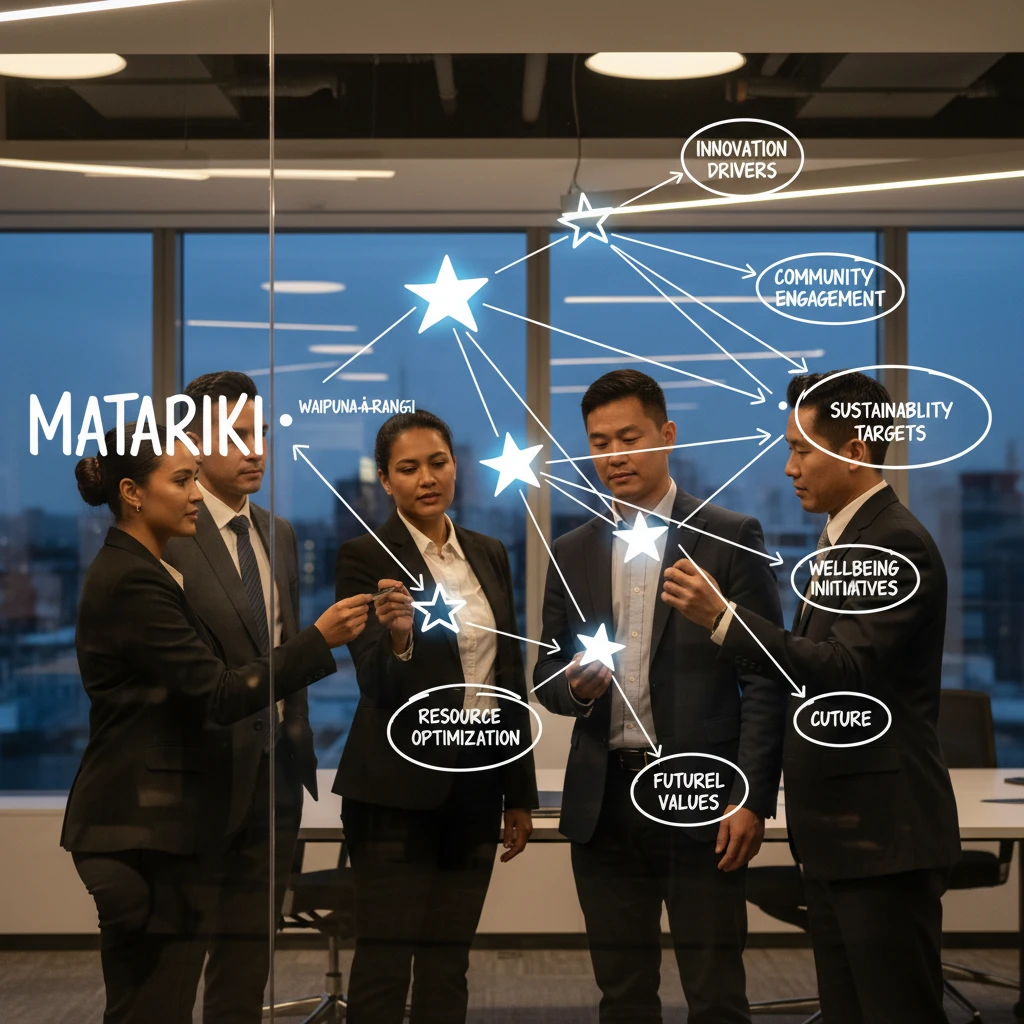
The most sophisticated workplace policies align the spirit of Matariki with corporate values. Matariki is fundamentally about three things: remembering the past, celebrating the present, and planning for the future. These pillars map perfectly to quarterly business reviews or strategic planning sessions.
Reflection (Remembering the Past)
Encourage teams to look back on the previous year not just in terms of profit, but in terms of people. Who have we lost (staff turnover)? What challenges did we overcome? A policy might suggest a “minute of reflection” or a dedicated team meeting to honor the hard work of the past year.
Connection (Celebrating the Present)
Matariki occurs in mid-winter, a time when morale can dip. Policy initiatives that encourage connection—team building, cross-departmental hui, or family-inclusive events—can boost engagement. This aligns with the star Matariki (the mother star), signifying the gathering of people.
Preparation (Planning for the Future)
Use the Matariki period to launch new initiatives. Because it is the Māori New Year, it is culturally appropriate to treat July as a “new beginning” for business cycles, distinct from the calendar new year in January. Your policy can designate this time for launching sustainability goals or community outreach programs.
Conclusion: Moving Forward
Creating a Matariki workplace policy NZ is more than a legal requirement; it is a statement of identity. It signals to your employees, clients, and the wider market that your organization values the indigenous heritage of Aotearoa. By moving beyond tokenism, ensuring strict adherence to holiday entitlements, and fostering genuine education, businesses can turn a public holiday into a powerful driver of culture and unity.
What creates a culturally safe Matariki policy?
A culturally safe policy is created through consultation with Māori, avoiding the appropriation of sacred symbols for commercial gain, and focusing on education and genuine understanding of Tikanga rather than just surface-level festivities.
Is Matariki always on a Friday?
Yes, the Te Kāhui o Matariki Public Holiday Act 2022 specifies that the holiday will always be observed on a Friday, though the specific date changes annually to align with the Maramataka (Māori lunar calendar).
Can an employer require staff to work on Matariki?
Yes, an employer can require staff to work if it is written in their employment agreement that they may be required to work public holidays. However, they must be paid time and a half and given a day in lieu if it is an otherwise working day.
How can small businesses celebrate Matariki on a budget?
Small businesses can celebrate effectively by hosting a shared morning tea, facilitating a team discussion on goals (Hiwa-i-te-rangi), or encouraging staff to learn a Matariki waiata (song). Authentic engagement is more important than expensive events.
What are the three major principles of Matariki?
The three major principles are: Remembering those who have passed (remembrance), celebrating the present with friends and whānau (celebration), and looking forward to the new year (planning/preparation).
How does Matariki fit into ESG (Environmental, Social, and Governance)?
Matariki aligns closely with the ‘Social’ and ‘Environmental’ aspects of ESG. The star Tupuānuku relates to the earth and sustainability, while the focus on community and whānau strengthens social governance and employee wellbeing.