
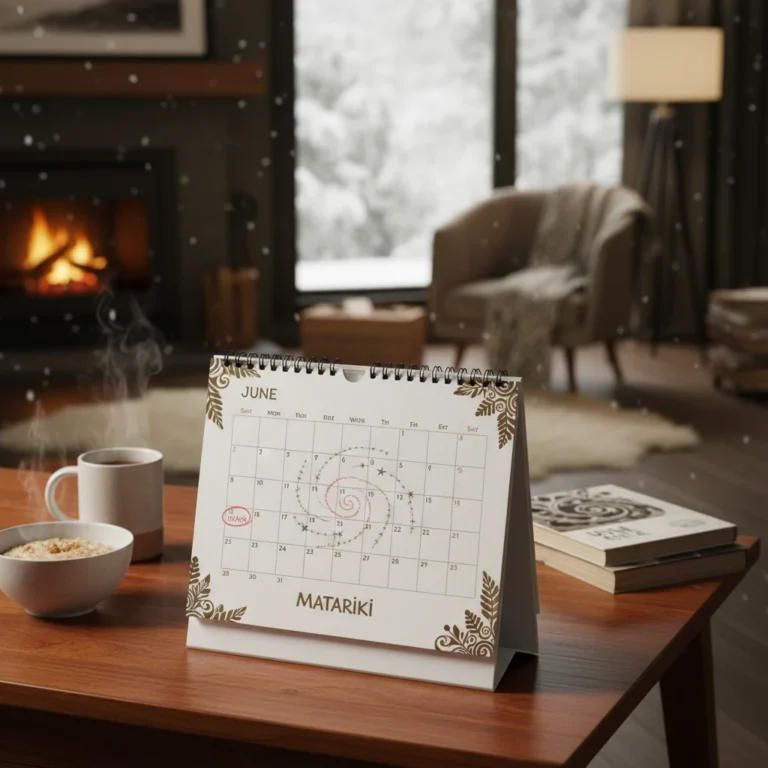
The Matariki public holiday in 2027 falls on Friday 25 June. You can see the Matariki star cluster low on the northeastern horizon between 5.30am and 6.30am. The public holiday is based on the winter rising of the Matariki cluster in the early morning sky during the Tangaroa period of the lunar month of Pipiri. Because of this, the dates to celebrate Matariki differ from year to year.
The public holiday date
The Te Kāhui o Matariki Public Holiday Act 2022 lists the observance date for each year in Schedule 1, and the date for 2027 is Friday 25 June 2027. The calendar date for the holiday shifts each year to align with the maramataka (Māori lunar calendar) and always falls on a Friday.
For 2027, the Tangaroa lunar period falls on 27 to 30 June, with the public holiday on 25 June. The Matariki public holiday dates fall on the closest Friday to the Tangaroa lunar period during the lunar month of Pipiri.
When the stars actually rise
The date of the Matariki public holiday is determined by the actual astronomical event of the heliacal rise of the Matariki star cluster, its first visible appearance on the northeastern horizon before dawn after its winter period of invisibility. Heliacal rising refers to the time when a star or cluster first becomes visible above the eastern horizon just before sunrise, after a period of being hidden by the sun’s glare.
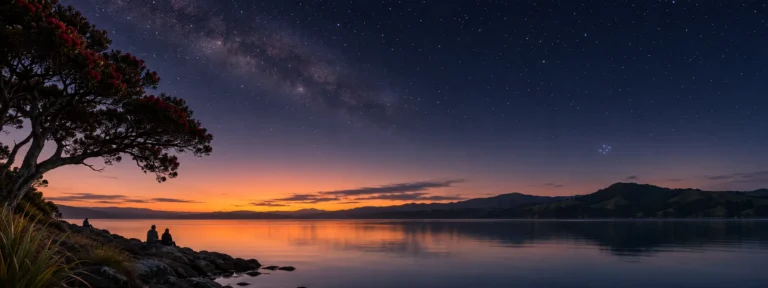
The stars appear in the last days of May or in early June, just before dawn, in the tail of the Milky Way. The stars themselves become visible from late June onwards, and the viewing period lasts for several weeks through early July.

What time to look
To find the Matariki cluster, face the northeast horizon between 5.30am and 6.30am during mid-winter, as this is the optimal viewing window. You should look toward the northeastern horizon approximately 30 to 60 minutes before sunrise.
Throughout the week, the Matariki star constellation is best seen in the early hours of the morning and when temperatures are at their coolest, particularly during takurua (the winter period). The exact sunrise time varies by location, so check your local sunrise time and aim to be in position about an hour before.
Where to look in the sky
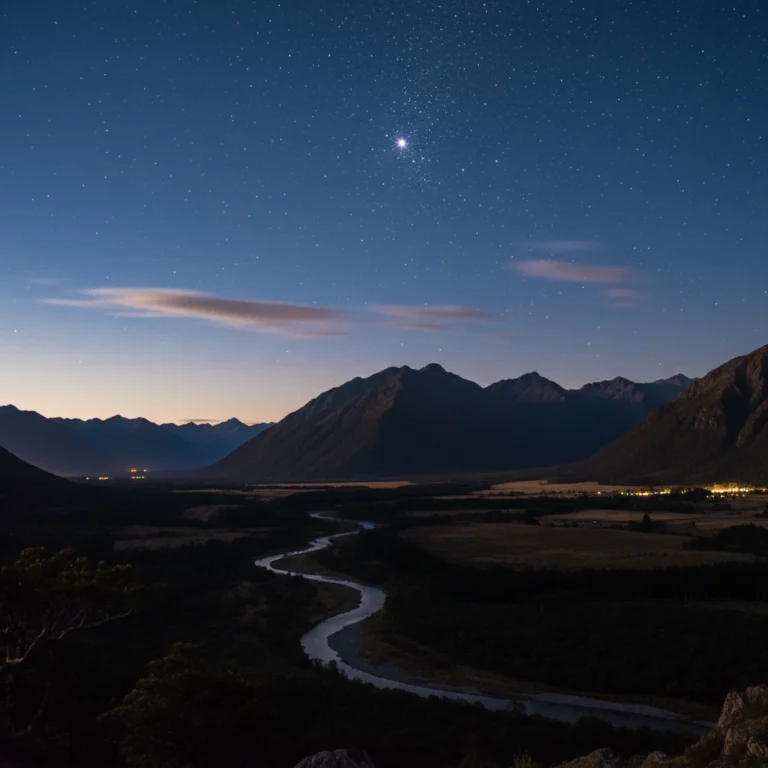
In Aotearoa New Zealand, Matariki comes into view low on the northeastern horizon. Matariki does not sit high in the zenith (directly overhead) during the early morning hours of the New Year period. It sits relatively low on the horizon, typically between 15 and 30 degrees elevation depending on the time.
Locate the three distinct stars of Tautoru (Orion’s Belt) and follow a straight line to the left. Your gaze will pass through the triangular cluster of Taumata-kuku (Aldebaran) before reaching the distinct cluster of tiny, twinkling stars known as Matariki.
You need a viewing location with a clear view of the northeastern horizon. Tall buildings, mountain ranges, or dense forests blocking the northeast view will make sighting the cluster impossible.
Regional and iwi variations
While there are regional and tribal variations, all Māori marked the New Year by observing the pre-dawn rising of stars in the winter. For some iwi the pre-dawn rising of Matariki, in the correct lunar phase of the correct lunar month, heralds the Māori New Year. For other tribes, Matariki is replaced by Puanga (Rigel) as the major marker of the New Year, while some look to Atutahi (Canopus).
Matariki’s reappearance in the northeast sky is not visible in all parts of New Zealand, especially in areas to the west of mountains. For some iwi in Taranaki and Whanganui, and on the West Coast of the South Island, the new year begins with the rising of Puanga. You can read more about these traditions in our guide to Puanga and Puaka.
If the weather does not cooperate
Because the heliacal rising depends on the observation of the object, its exact timing can be dependent on weather conditions. For some parts of Aotearoa, the Matariki star cluster is not always visible, which is linked to light pollution or environmental factors such as kohukohu (fog and mist).
The holiday date is set based on the calculated rising of the stars, regardless of local weather conditions. Even if it is cloudy or raining, the holiday proceeds. The Matariki viewing period lasts for several weeks, so if the public holiday morning is cloudy, you can try again on any clear morning in late June or early July.
For tips on viewing Matariki from urban areas, see our guide to urban stargazing. You can also find dark sky locations in our guide to where to watch the Matariki stars.
Planning your Matariki 2027
Matariki 2027 is on Friday 25 June, giving New Zealand a three-day weekend from Friday 25 to Sunday 27 June. It is the sixth time the country has marked Matariki with a public holiday, and the date is set in law, so you can plan around it now.
Matariki falls during school term time. In 2027 it is in the second-to-last week of Term 2, which runs from Tuesday 27 April to Friday 2 July, so families get a long weekend a week before the two-week winter break starts on Saturday 3 July.
For ideas on what to do over the long weekend, see our guides to festivals and celebrations, dawn gatherings, and stargazing and astronomy events around the country. Regional event listings can be found on our pages for Auckland, Wellington, Canterbury and other regions.
Our guide to Matariki 2027: when it is and how to celebrate covers the full season of events and traditions.
Sources
- Te Kāhui o Matariki Public Holiday Act 2022, Schedule 1 (New Zealand Legislation)
- Dates for the Matariki public holiday (Te Papa)
- Heralding the new year (Te Ara: The Encyclopedia of New Zealand)
- Matariki dates 2022-2052 (Matariki Advisory Committee, Professor Rangi Matamua)

Independent Matariki guides from 0 Digital, Aotearoa New Zealand, researched from published sources and checked with care. Details change, so check with the operator or the official source before you go. Spotted something out of date? Tell us.
 Public holiday
 Public holiday
 Public holiday